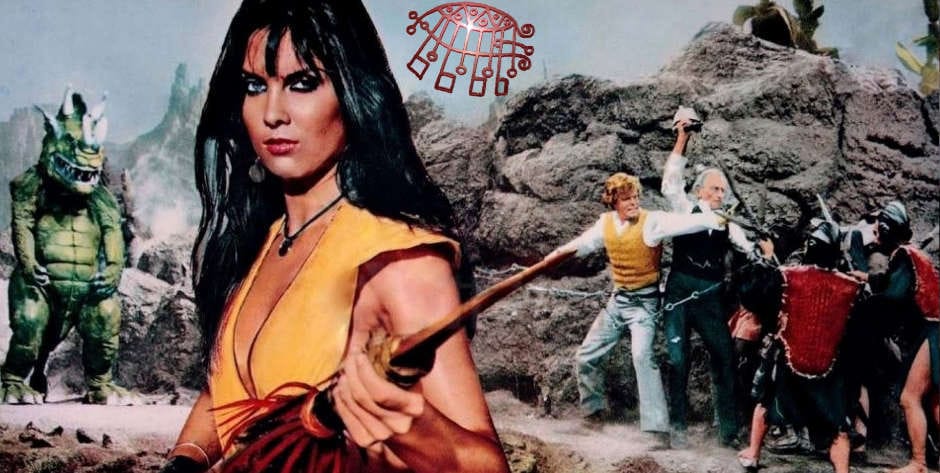
When Caroline Munro laughs, it lights up the room. During our conversation, she laughs a lot, and each time her laugh tells a different story. When I mention that I grew up watching The Golden Voyage of Sinbad with religious regularity, she responds with a warm, almost apologetic pearl, followed by a sincere, “You must be so sick of it!”
Later, when the topic turns to her iconic parts in Hammer films, it is a light, almost incredulous chuckle. “It’s funny, isn’t it?” She marvels at the idea that she, young Caroline, was offered a multi-film contract for one of the legendary film houses at the time.
She describes herself as an instinctual actor. “I can only say my school is to be instinctual as to what's happening at that moment in time, and that's how I reply. But I do listen. I’m a bit of a sponge that way; I like to observe.”
In person, she is immediate and approachable. When we talk, her gaze doesn’t falter, and it feels like you’re the only person in the world that she has chosen to speak with.
But mention any of that to her, and chances are that Munro will laugh and swat the thought away, or direct the praise to one of her numerous legendary co-stars. It isn’t insincere, either, and Munro doesn’t downplay her numerous accomplishments. At least, not by a lot.
It’s because there is so much to talk about, and Munro is a fountain of anecdotes and history. At just 17, she was already the cover girl for Vogue magazine in London. A few years later, she got her start in films by starring in Casino Royale, the riotous satire of Bond films, and the aforementioned Hammer productions.
Her magnetic screen presence brought her back to an official mainline Bond picture in The Spy Who Loved Me, where she and the towering Richard Kiel tormented Roger Moore as a pair of assassins. She lit up the screen in high-concept fantasy like At Earth’s Core and garnered praise for her part in the avant-garde horror comedy The Last Horror Film.
And that’s just in the first 15 years of her career.
Today, Munro hosts a weekly series, The Cellar Club, that celebrates obscure and underappreciated horror films of the past, and serves as a board member for the Ray Harryhausen Foundation. She’s in town for the Night Visions International Film Festival as the guest of honor to celebrate an illustrious career with genre fans who grew up with her works.
Our talk lives in tangents. Every story is littered with detours and asides, and it's as lovely as it is lively. It is edited for length and clarity.
Here is Caroline Munro in her own words.
Joonatan: I want to start with your Hammer history. Because you were one of the only, if not the only, actors who got offered a contract with Hammer at the time.
Munro: I know! It’s funny, isn’t it, really?
Joonatan: Looking back on it, how do you remember your time with Hammer?
Munro: I have such wonderful, wonderful memories of being that little part of Hammer. It came about by accident, too; I started as a model many hundreds of years ago, and I did a big campaign for Lamb’s Navy Rum. They had big billboards all over the place, much to my father’s–
She trails off, smiles, and laughs.
Munro: They were fine, they were okay, they were strong, and they were quite powerful at the time.
Munro: Sir James Carreras at Hammer had seen the posters all over London, all over the stations. This is what I heard later. And he said, “I’d like to see her in the office to just meet with her.” I think he’d seen a couple of things I’d done before—just small bits.
So, I met him, and he asked me if I would like to do a screen test. I did one with a lovely director called Peter Collinson, who sadly is no longer with us. I didn’t have to learn anything; he just said, “Just chat, and we’ll watch you chatting.” I said, “Well, that’s a bit boring.” He said, “No, just chat.” So, we chatted. And then they offered me the contract! Because I thought it was going to be one film, but it was, in fact, luckily, two films with Hammer.
Hammer was doing so well at that time, even though it was towards the end of that era. It changed over time, because I think people were starting to look to America for all the slashers and a different kind of horror. It became much more graphic, and younger people gravitated more to that than old-school Hammer, which was Gothic and beautifully shot.
Hammer was the best time. You had the best DPs, and you had great directors; old-school directors! I got to work with Alan Gibson, who was a Canadian and a lovely, lovely chap. Knew exactly what he wanted. He was very straight, very direct.
I’d had no training at all; I hadn’t been to drama school. I’d worked in front of a camera as a model, and I did a film with a photographer, very famous in the UK and maybe Europe, called David Bailey. I did a short film with him. A black-and-white short called G.G. Passion, but it’s a little-known film. I had done that and another film even earlier when I was just sixteen. I was an extra with an Italian director and actor called Alberto Sordi.
I didn’t know that nobody else had been under contract. Shane Briant, I think he was contracted. I’m not sure, but I believe I was the only woman, which is very bizarre.
I did two films with Hammer: Captain Kronos and Dracula A.D. They were done on a very short time scale. You may have had four or five weeks, with kind of minimal budgets. They did not spend a lot. Obviously, Christopher Lee and Peter Cushing were paid, and we were paid, but at the time, it wasn’t much.
But it was working with all these wonderful technicians and actors that was exciting for me. I was so nervous going into Dracula A.D. because I’d been an extra, so I’d watched. I’m a bit of a sponge that way; I like to observe. And that’s how my training came, when I was an extra on the original Casino Royale.
That was with David Niven, Woody Allen, Orson Welles… I mean, you had all these huge names, and I was an extra. And they had four or five directors on that film, and I had a director called Val Guest.
Joonatan: I’ve met Val Guest.
Munro: Did you really?!
Joonatan: He came to the Sodankylä Film Festival up north in Lapland. This was almost 25 years ago. I was 15 or so. He was already hard of hearing by then, but he was so patient with my questions because I was effusive about the films that he had made.
Munro: Yes! I mean, he made so many big films; a lot for Hammer, but a lot of other stuff too. He was a huge director.
Joonatan: He did Quatermass, and one of my favorite films of all time, which is The Day the Earth Caught Fire.
Munro: That’s a great film. A wonderful film. Oh, that’s so lovely! Well, he was my director for my bit of my extra work. And we were shooting in MGM Studios, which was huge at that time.
They were making big films when we were shooting Casino Royale. One of those was The Dirty Dozen. All the girls were so excited. I was the youngest one there, and the girls said, “Come on, Caroline, let’s go and see all the men, all these wonderful actors in the canteen”. I said, “I’d like just to stay and watch these actors working”. So, I asked Val, and he said, “If you sit quietly on the side, you can watch.” So, I watched Woody Allen and Orson Welles, David Niven, all these actors working, doing their scenes. That was my learning curve.
Casino Royale obviously had a massive budget because it ran way over time, I believe. I mean, it was going on for months and months with the biggest actors around. But I watched how the actors prepared their scenes. I watched the lighting. If I ever went back in time, I would be a lighting person. That’s what I would choose to do, because I find it fascinating.
But that was Hammer: small budgets, tight schedules. But the crew worked like clockwork because they’d all worked together for so long. It was an extraordinary thing; they’d worked together on many, many films. They were old hands at doing it.
It was like a regiment; they all slotted in, they all knew their places, what they were going to do, from the sparks to the cameramen to all the different people, and we were included in the team. Nobody was bigger than anybody else. I mean, I don’t know if Christopher would agree with that. Christopher was the star, as was Peter. But it was a joy to make.
Joonatan: What was that experience like, working with Lee in Dracula?
Munro: That was the first time for me, working with Christopher, that I realized that’s really what I wanted to do. Because my character, Laura Bellows, was young and impetuous, she wanted to try anything to be the center of attention. She was a silly girl, really. But I embraced her.
When it came to working with Christopher, we got on really well. I found him great, very interesting. He was always telling me all about Transylvania and stuff, which I found fascinating. When it came to my scene, I said to Alan: “Do you mind if I don’t see him before he comes out as Dracula?” Because I’d only seen him in his civvies at that point. "I’d prefer to see how I feel when I do see him as Dracula”.
So, we started the scene. I’m lying on the altar, and the wonderful actor Christopher Neame was doing the build-up of summoning up Dracula. Back in the day, obviously, no CGI, so everything had to be done practically, including the blood that they used in my scene. I had the goblet, and they hooked up an amazing sort of pump underneath my shroud, and then the blood flowed. So, my reaction was real because I was covered in the stuff.
At that point, I thought, “What am I doing?” I’m crying, my eyes were tearful, and I felt a bit sorry for myself—or she did, Laura. And then, in the midst of crying and sobbing, I was there. And I’d never experienced that before. Then, suddenly, Christopher appeared through the ever-blowing, dark black curtains in the church. And he’s so tall, but with his black cloak with the red lining, he looked even taller. His face was white, and his eyes were red!
From that moment on, after he’d bitten my neck—beautifully, I might add—I thought: “I think I can do this. I think if I can get that same feeling of believability, I can carry on doing a bit of acting if I’m asked.” And that’s what I did.
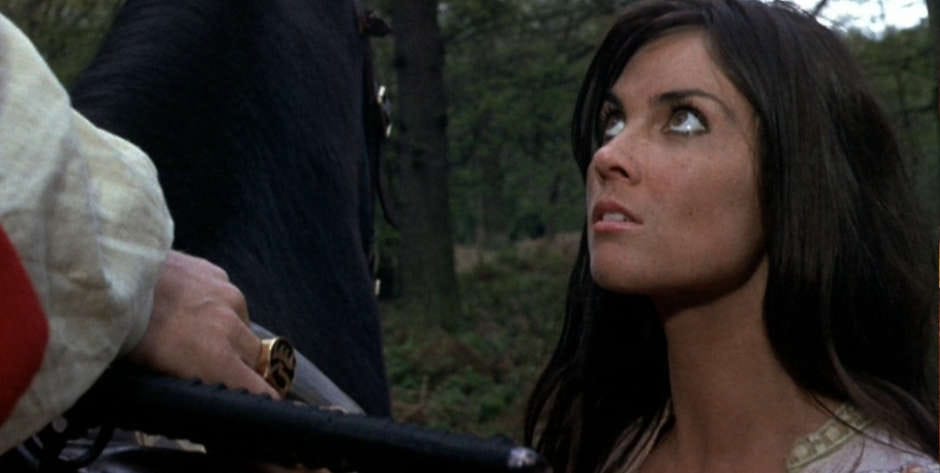
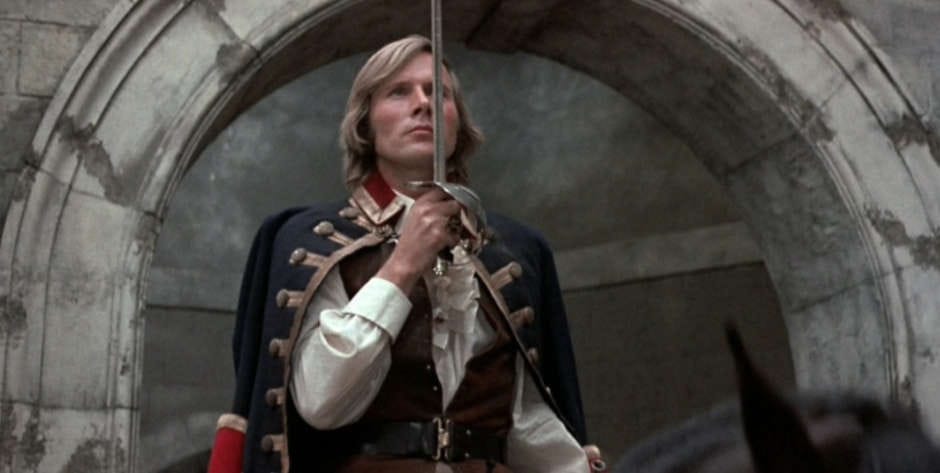
Then came Captain Kronos, which is one of my favorites. They're showing it at the festival. I won’t sit through it again. I get embarrassed, really. But they’re showing it, and I love that film. It’s shot all outside in the countryside. I had one costume, and I was barefoot throughout with a lot of mud on my face! But it’s more like me than anybody else has been, character-wise.
I loved working with Brian Clemens, who was a total genius. He wrote it; he also wrote the screenplay for Sinbad. He was wonderful to work with, and it was his first time directing anything. Kronos was his baby.
He didn’t want me for the part at first, apparently. He said, “No, she’s not right. Not right for my gypsy.” But I was under contract to Hammer, who said, “Well, I’m afraid you’ve got her.”
He changed the script, and he wrote it around me, so it was downplayed, I think, which suited me. It was good, more naturalistic.
I loved working with him, and Hammer itself. John Gore, who has now taken over Hammer, has some really good projects coming out. It's really exciting.
Joonatan: You’ve already touched on a lot of things I wanted to ask, but one of the things that I love about your performances is that you're a great listener as an actor. I love watching people on screen when they're not the ones talking.
In your performances, you're so alert, so in tune with what is happening in that immediate moment. What was that like in a production like Sinbad, which has a lot of effects? Knowing how stop-motion works, it must be difficult for the actors because of the technical work.
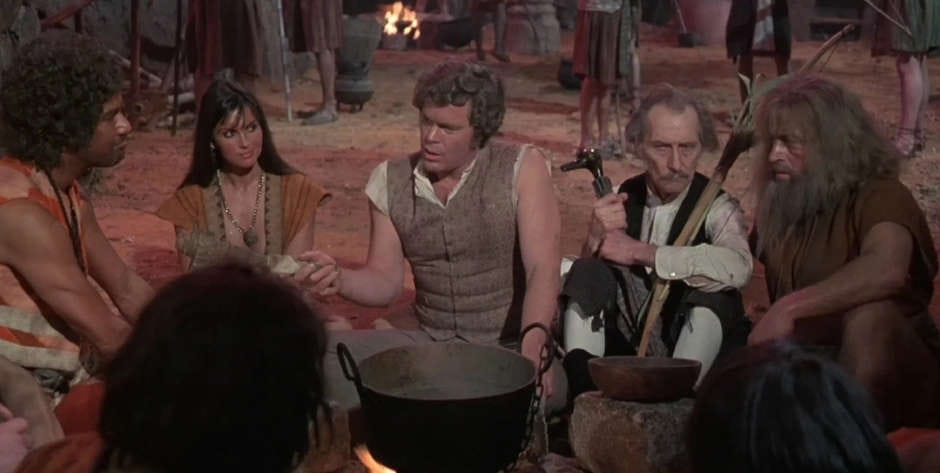
Munro: I was an only child, and I played a lot by myself, so [working on Sinbad] was almost like becoming a child again. With Ray Harryhausen in particular, with the stop-motion, because you don’t see anything except his beautiful artwork, which he would show us before we went on, and explained what was going to happen. But you never knew how it was going to look. It was a lot of listening and learning. You're learning all the time.
That's also true when you're working with another actor. Like with Christopher, a huge star, I thought, "I am scared, but I'm going to listen." If I can glean something from him, his knowledge, and his expertise as an actor, then I will listen.
I think if you can get there as your character, and very often I haven't been there, I haven't been present, and I can see it. I thought, "Mmm, that's not very good, you're not really there." So that annoys me, because I don't have the craft, as it were, to depend on. I haven't learned the techniques to, you know, method or anything, I haven't done that. I can only go by instinct. I can only say my school is instinctual. Listen to what's happening at that moment in time, and that's how I reply. But I do listen.
That's something Roger Moore taught me. He was such a wonderful actor, even though he was so self-deprecating. He would deliver his lines, and you would do your lines, but he didn't step away or go to his trailer when he was done. He would be there for me to deliver my lines, whereas a lot of actors, big actors, have a stagehand or the first AD do their part. But not with Roger; he was there, you know, which I so respected. He was a lovely man.
Joonatan: I remember when they still allowed us press folks to come on set; it was such an important lesson to see which actors stayed to read with the other actors. Now, when I watch movies, I can still tell when someone is playing off another actor or not.
Munro: You can see it in the other actor's eyes. It is a difference, because if you have a script reader instead of an actor, they're looking down, and it's not the same.
At this point, we're told that time is running out. Munro has other interviews, and we've only just started. I skip ahead in the timeline by decades, across Munro's evocative work in fantasy and horror, and past her second music career.
Joonatan: Today, you work with the Ray Harryhausen Foundation.
Munro: I do, yes! They have the collection in Scotland now, which is amazing.
Joonatan: What is that work like?
Munro: The Harryhausen Foundation inspires and helps young animators and sponsors people like that. It archives, preserves, and restores Ray's work, which is so alive and kicking still after all these years. But it’s—he was an extraordinary man. Did you get a chance to meet him?
Joonatan: I never did.
Munro: Oh, you’d have loved him! He had a very loud, American but anglicized accent. And he was just so sweet and so modest. When we’d go to a show, Wonderfest, somewhere in America, there were lines around the block. Obviously, it was Ray Harryhausen!
He said, "But why?"
I said, "Because of you! It’s you, that’s why they’re here. They’re inspired by you. They love your work".
"Well, I don’t understand."
I said, "Well, I do. I understand it. I’m lucky enough to work with you. You’re a genius". I call him the Godfather of Special Effects; that’s my name for him.
Once again, we're told it's time to wrap it up. Coffee arrives. There's still a long day ahead. We chat about art, time, and Munro sweetly offers words of encouragement.
Munro: The world is your oyster. That's what my late husband would always say: "The world is your oyster."
Joonatan: I keep thinking: what happened? I was twenty just a blink of an eye ago. It's very cruel, this linear time business.
Munro: I know, yeah. Especially when it marches on, and there's a new creak one morning, and you think, "Oh, that's not very nice."
Joonatan: I can’t even fathom time on a conceptual level, but you have the added element that there’s an image of you that exists forever; this idea of you from these films. For me, there are pictures of me as a kid. They won’t see the light of day. But everyone will know an image of you from the '60s, '70s, and '80s.
Munro: Maybe. I hope so. You never know, do you?
Joonatan: I certainly think so. But how do you see yourself? Do you wake up in the morning and think, "Well, I’m an icon of sorts?"
Once more, Munro laughs. This time, it's an instant, loud, and sparkling sound with a hint of self-deprecation. The world is brighter for a second.
Munro: No! You’re joking! No. I’m a dyslexic technophobe hoarder. That's how I would sum that up. But I have two amazing daughters, and they have been my two pillars since my husband passed, which broke my heart. They are extraordinary. They’ve been there every step of the way. Through cancer, and... I’ve been through a lot the last few years. But so far, you know, I’m still here. I’m still very excited to travel and to meet people like you in Finland, which I’ve never been to before.
I still really enjoy what I do.