

Distributor provided review access to product.
I grew up in a time where gaming cafe's where hugely popular. When I studied abroad in Australia, I had no money for a gaming console, let alone a PC, but on occasion I could swing an afternoon playing my favorites at the local establishment.
GeForce NOW operates on the same basic idea, but without the need to find a cafe or even leaving the comfort of your own home. It works on PC, Mac, Android, iPhone, and even some Smart TV's, rarely requiring more than a simple login to begin a gaming session.
Unlike other subscription services, GeForce NOW doesn't offer a library of titles like the Xbox GamePass or PlayStation Plus. Instead, it connects to your established libraries and offers the hardware to run them in varying levels of fidelity, regardless of your operating system or platform.
The price points are reasonable, too. You can even get started with a free account, which should do in a pinch for most casual gamers. But there's something truly wild about the ability to just start up your phone and play any AAA-title that you own on Steam just like that.
There are downsides, including the occasionally wobbly connections and input lag on a TV setup, but they're surprisingly easy to overlook when the actual experience is this seamless and fun.
Here's everything I learned in the last month and a half of using the service, who it's for, and what you should know before getting a subscription.
Pricing and availability
GeForce NOW is available on PC, Windows, portable devices like the Steam Deck and ROG Ally, and can work on both Android and iOS. It does not work on either PlayStation nor the Xbox Series consoles.
At the time of writing, there are three tiers of subscription. The free one offers a base of 1-hour gaming sessions with stricter limits and a 1080p resolution cap. For casual and one-off use though, it's a more than capable offering.
The mid-range tier is 10€/month, though NVIDIA is running a deal for half off at the moment. It offers a far more robust approach to streaming with up to 1440p in resolution and 6-hour gaming sessions. Both it and the Ultimate tier have a monthly cap of 100 hours of game time, which means a little over 3 hours daily. It is possible to purchase extra time for both tiers.
The Ultimate tier, which is what I've tested these past weeks, is the everything-but-the-kitchen-sink approach. Up to 4K resolution at 240FPS, RTX 5080 GPU on supported games, HDR10 and DLSS3 frame generation all come included.
By comparison, a similar rig bought outright would be in the 4000-5000 Euro territory with the way prices are today.
Granted, prices are as such because of companies running ragged after AI and jacking up costs of GPU's and RAM in the process, which is a whole other can of worms.
As it stands, the pricing tiers on GeForce NOW offer a surprisingly good bang for the buck, especially considering how they're not tied to a single operating system. A single subscription lets you pick up and play on your chosen platform, and that is undeniably cool.

Gaming on a Windows PC
Arguably, GeForce NOW is best experienced on a Windows PC, which is kind of the default setting in the first place.
My test rig which I use for reviews is not exactly top of the line, but just acceptable for 1440p gaming at medium to high settings. Considering Steam's annual hardware survey, which shows the majority of gamers only just moving out Full-HD with RTX 3060 graphics cards as the majority, it's a fair representation of the epxerience most will get.
So, like many, I immediately jumped into my most demanding titles to check out how they run when hardware isn't a concern.
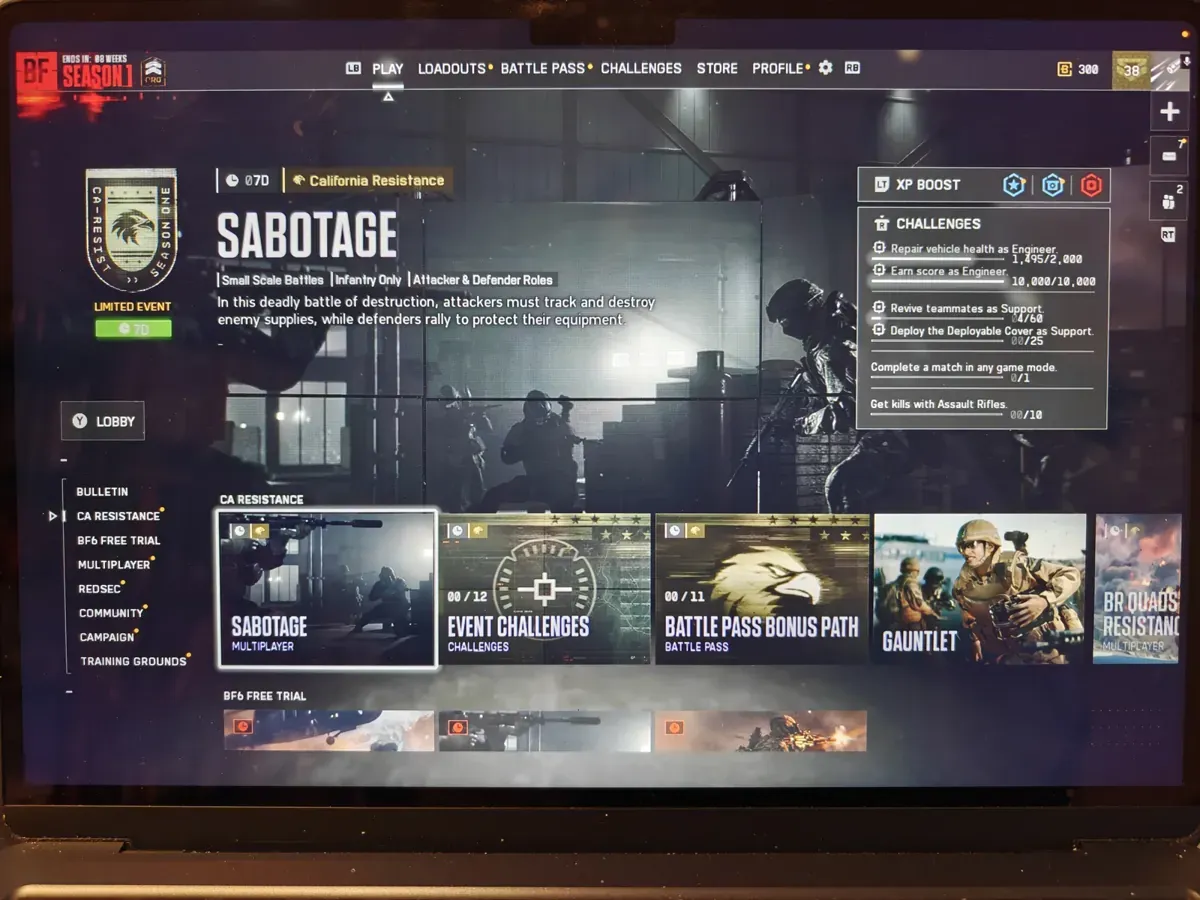
I started out with Battlefield 6, which already runs OK for the most part, though it's clear that my aging CPU (an i7 without hyperthreading) is clearly no longer up to the task. Within minutes, I could see what I was missing out.
On GeForce NOW, the experience is smooth, gorgeous, and entirely playable even as a streaming title. My internet connection is the fastest my provider allows at 1gb download and 500mbs upload, which meant a solid and stutter free experience for the most part.
I say mostly because on the rare occasion the connection did stutter, the experience is noticably weaker within seconds. Input lag kicks in hard and it takes a few seconds for the stream to recover. This proved to be the biggest consistent problem with GeForce NOW, especially when the reality is that most service providers will cut corners in delivering rock solid connections even on cable connections – let alone with 5G.
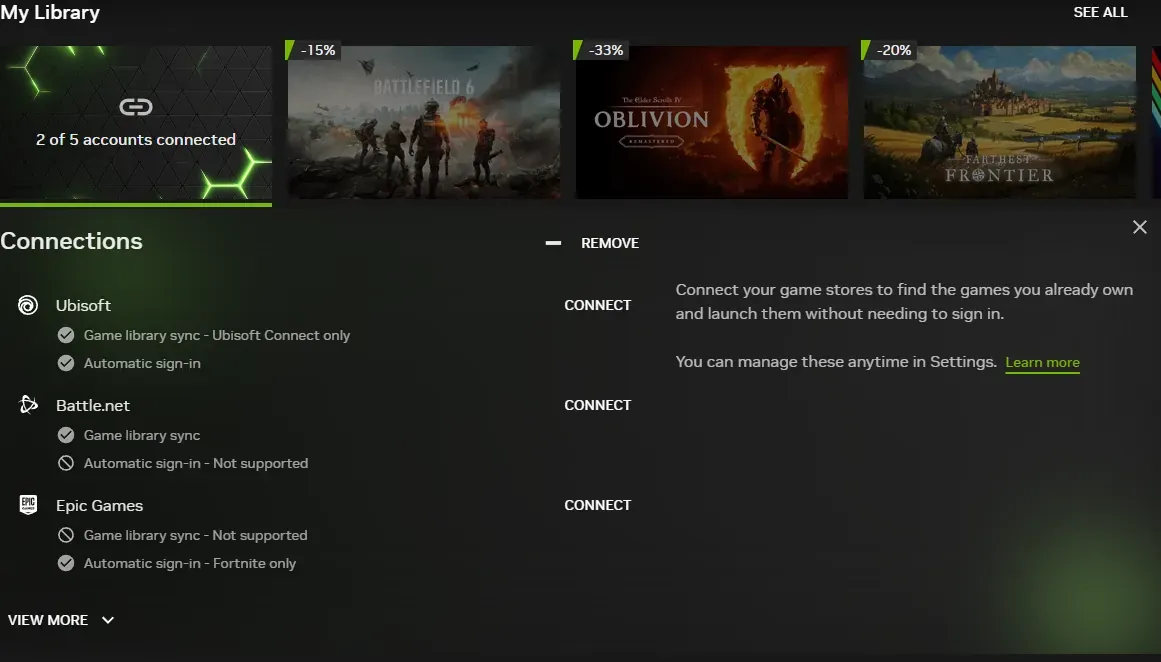
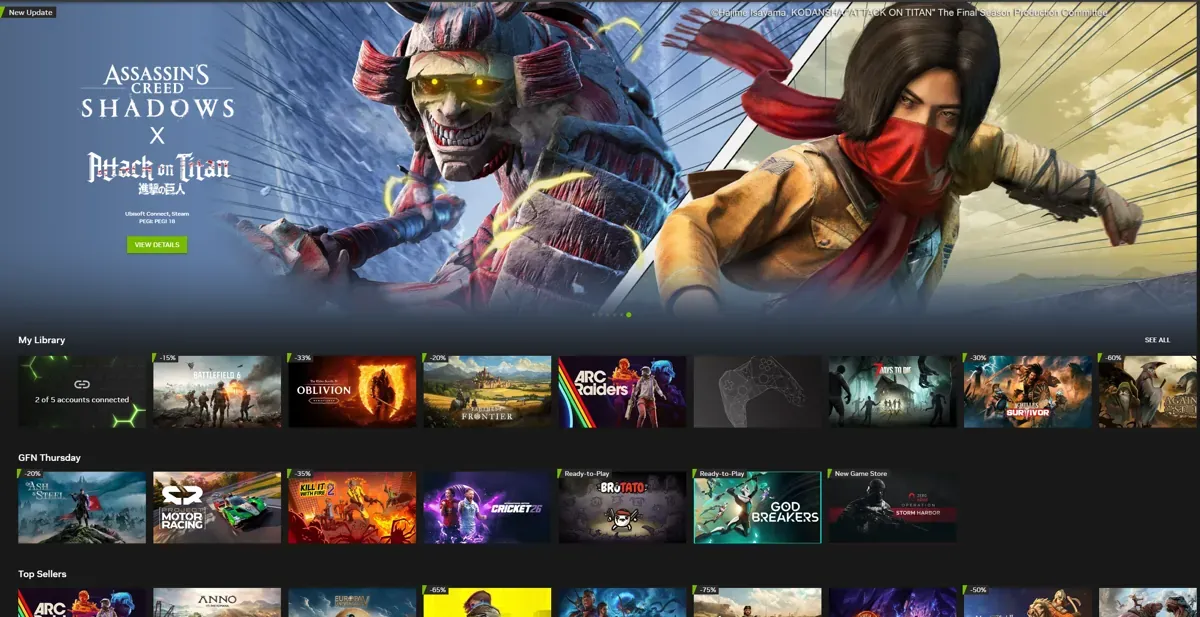
Signing in and syncing your library is very easy and the Netflix-style management is intuitive for the most part. At the time of writing, Epic Games did not allow me to sync my library into the service, and not all of the titles I wanted to play were available. NVIDIA is constantly working to update their roster with monthly additions dropping all the time, so this is hardly a permanent state of things.
GeForce NOW offers also an Install-to-Play option, which creates a single-session cloud storage for your chosen game that eliminates the streaming downsides entirely. It' s a novel idea, but the roster for games is limited to older and indie titles, and so far I didn't get as much use out of it as I did from everything else.
Gaming on a MacBook
My biggest surprise and delight with GeForce NOW came on the road. I had my trusty MacBook Air M4 with me, which I use for writing, editing, and podcasting while I'm out of town or covering festivals. It's an incredible device that sadly still isn't good for gaming and is stuck with a miserly 256GB of storage.
So when I realized I could just login to my GeForce NOW account and continue playing Battlefield 6 or Kingdom Come: Deliverance 2 anywhere with a stable internet, I was blown away.
Yes, it's not a new thing, but it's also never been as refined as it is now. There are no extra hoops to jump through, no major caveats. It just works.
I paired my 8BitDo Ultimate 2 controller with the MacBook and the experience was as close to playing at home as I could have hoped for.
Again, some things to consider: my hotel had a very solid and fast Wi-Fi connection, which meant that gaming was mostly entirely passable. I did notice quickly that Battlefield 6, which is a fast-paced and hectic game, wasn't particularly suited for this connection type. I experienced too much input lag and too many stutters to really enjoy the experience – but again, this was in a hotel room and on a MacBook, something that would have been unimaginable just a few years ago.
Once I moved to Kingdom Come: Deliverance 2, the experience proved far more serene. The slower pacing worked perfectly with the more limited and shared hotel connectivity, and I quickly lost track of time wandering around a blockbuster title on a machine it had no business working on.
It's here that I can see the most enticing proposition for GeForce NOW: users who aren't hardcore PC gamers and who don't have the instinct to buy a console outright. Granted, that's an oddly specific subset of people, but it's also a number that appears to be growing every year.
After all, more and more people own smartphones and tablets over laptops, and MacBooks are still the best deal when it comes to working laptops for everyone. Pairing any of those with GeForce NOW feels like an ideal solution.
Gaming on a smartphone & TV
My final set of tests came with two smartphones and my TV back home.
To start off, I took along my OnePlus 15 review unit, which was my daily driver for most of the past month. I also brought along my personal Samsung S23 Ultra, which is what I use regularly when I'm not reviewing new devices.
I then paired both of them to the Razer Kishi V3, which I reviewed earlier in the autumn.
 Joonatan Itkonen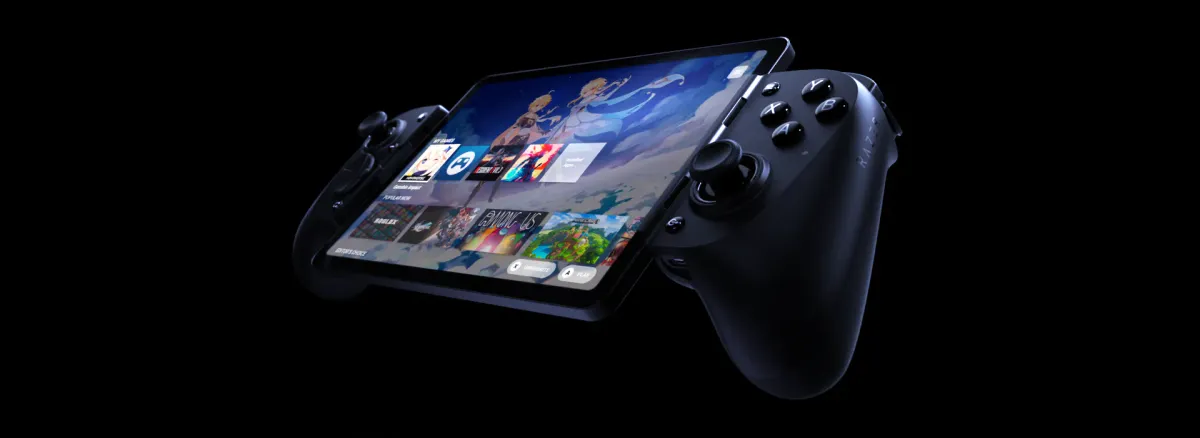
On Android, the GeForce NOW app is just as easy to use and intuitive as on the PC, though I did find the actual Steam integration a tad more fiddly. Especially once you've started a game, Steam just doesn't want to play nice with the Android interface, and adjusting settings or turning off the service proved annoying even on games that have native controller support.
Grumbles aside, GeForce NOW proved itself a surprisingly capable experience even on a smartphone. This was the one area which I was most suspicious about, as mobile streaming has been a pain point for almost every service provider in the past decade. While the Xbox Games Pass has made huge strides here as well, it GeForce NOW that really sealed the deal in selling me a vision of this future.
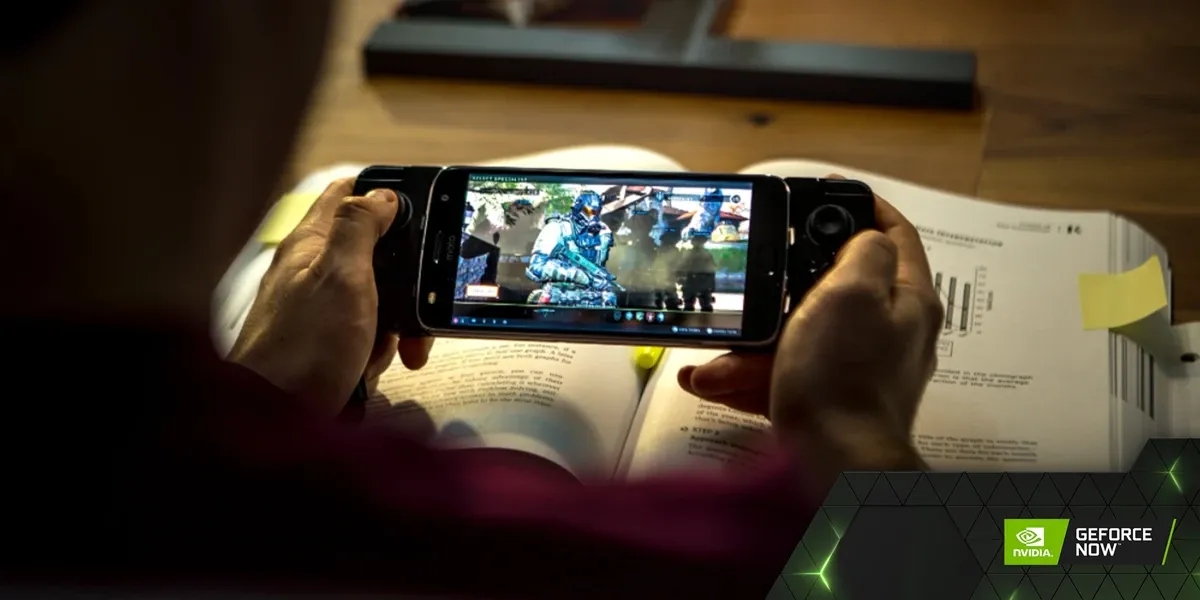
I tested the connection with both Wi-Fi and 5G, the latter of which was capped at 200MBs speed. On both the OnePlus and Samsung, GeForce NOW worked wonderfully on a Wi-Fi connection and with slower paced titles. This time around, I went with Indiana Jones and the Great Circle, which is a surprisingly demanding titles if you want all the graphical goodies activated.
Even on a just a 7-inch OLED screen, the quality was noticably gorgeous. Multiple times during my test period, I had to remind myself that this wasn't some pared down version of the title. It was the full thing without a single compromise, running beautifully in my hands and on the road.
On 5G, the experience proved a little less stable, with even Indy suffering from input lag and stuttering, despite both devices showing full bars in the center of town. It should be noted that these issues didn't last and that even mobile gaming on a metro, train, and at a crowded terminal proved entirely passable around 90% of the time.
As for the TV experience, well, things were less than rosy. Again, this one comes with some disclaimers: my TV is the Sony X950H, which is around six years old now. The Wi-Fi card in it was barely passable even upon release. The Android operating system within is janky to put it kindly.
I tried out Oblivion Remastered and found that even with all the settings turned on for a gaming experience and with a rock solid connection to GeForce NOW, the input lag was so noticable that I couldn't enjoy myself one bit.
Yes, it still looked amazing, and there is a huge novelty factor involved as well, but this wasn't an ideal test scenario. Especially since I have a variety of consoles right next to my TV and there's the Steam Box on its way next year.
Downsides and considerations
While GeForce NOW is mostly an excellent proposition with immensely desirable perks to its name, it isn't perfect.
The previously stated technical hiccups should be taken into consideration and weighed against your own gear and location. Despite the incredible headway that NVIDIA has made in the past years with their streaming solutions, it is still streaming, and if you play anything that's demanding or fast-paced, you'll want to also have the best possible internet and very little to get in the way of that.
You also have to buy the games separately, which adds to the costs of the actual experience. If you already have a robust Steam library, that consideration is far lesser. It's both a blessing and a curse in a way. I appreciate that you actually own your products (as much as digital counts as ownership), but you're still very much stuck with buying things and paying for another a subscription just to use them, which isn't ideal in the long run.
Finally, there are the environmental concerns. These streaming solutions are inherently tied to server farms, which also power AI, and which still pose countless of unanswered questions regarding how much they actually drain resources. I realize it's not something most will immediately wonder about, but considering how the digital future is sold on the back of ecological concern over physical media, I can't help but wonder just how much we're actually saving on this front.
Is it worth it?
For all my griping and handwringing, it's very, very hard to argue against the value proposition that GeForce NOW offers. For 10 Euros a month, you get to have a portable gaming solution anywhere you go and almost entirely regardless of the platform of your choosing.
Streaming has also come a long way since I first tried it, and I could tell during my testing period that it is consistently improving on a weekly basis. It is a wild experience to play AAA-titles on a smartphone, and it was one of the most consistent conversation starters with friends and strangers, who would ask just what the heck was I gaming on to get something of that quality.
If you already have a library of Steam games but without the hardware to keep up with the increasingly demanding titles, GeForce NOW is a no-brainer. If you're curious about the offering of the PC market, I'd recommend trying out the free or middle-of-the-road tiers first for a month.
It's not yet the solution for everyone, but it's very, very close, and the fact that we've come this far in such a short period of time is immensely fascinating. As it stands, GeForce NOW delivers the technology of tomorrow seamlessly into everyday gear and is almost the perfect example of cloud gaming you could hope for.


