Distributor provided a review copy
Of Ash and Steel isn't for everyone. In fact, I would argue that it isn't for most people, and even some of its target audience should give it a miss.
It is a janky and unfinished game with a myriad of issues from the technical to its core design. Parts of it are so broken that you could easily mistake it for an early prototype rather than a finished title.
The combat is awful, mechanics are unexplained and messy, exploration is unintuitive, the writing is poor, and voice acting is unintentionally funny. At worst, Of Ash and Steel suffers from game breaking bugs where quest items disappear entirely or characters refuse to engage in necessary dialog because of a broken script.
I've also encountered characters where the audio is clearly unfinished. A daring rescue turned into a comedy of errors when the the voice actor flubbed a line and proceeded to do a second take while their NPC sat mouthing at open air.
During my review period, an update caused my save files to vanish, resulting in the loss of my entire progression to that point. At another point, an NPC told me they would buy certain types of items, at which point a random answer suddenly sold everything in my inventory!
The looting and stealing mechanics are unintuitive, which often lead to questionable outcomes. There's no way to know if you've committed a crime or how much your bounty is. Because of the broken economy, it can suddenly be in the thousands. Guards will spot your crimes through walls and even from miles away without any notification. Good luck at attempting lockpicking or any of the mini-games, as they're so poorly explained and implemented they might as well not exist.
Taken on their own, any of these issues would be understandable for a small indie title with limited means. As a collection of repeating and often devastating errors they become a clear showcase of a product that was never ready for release.
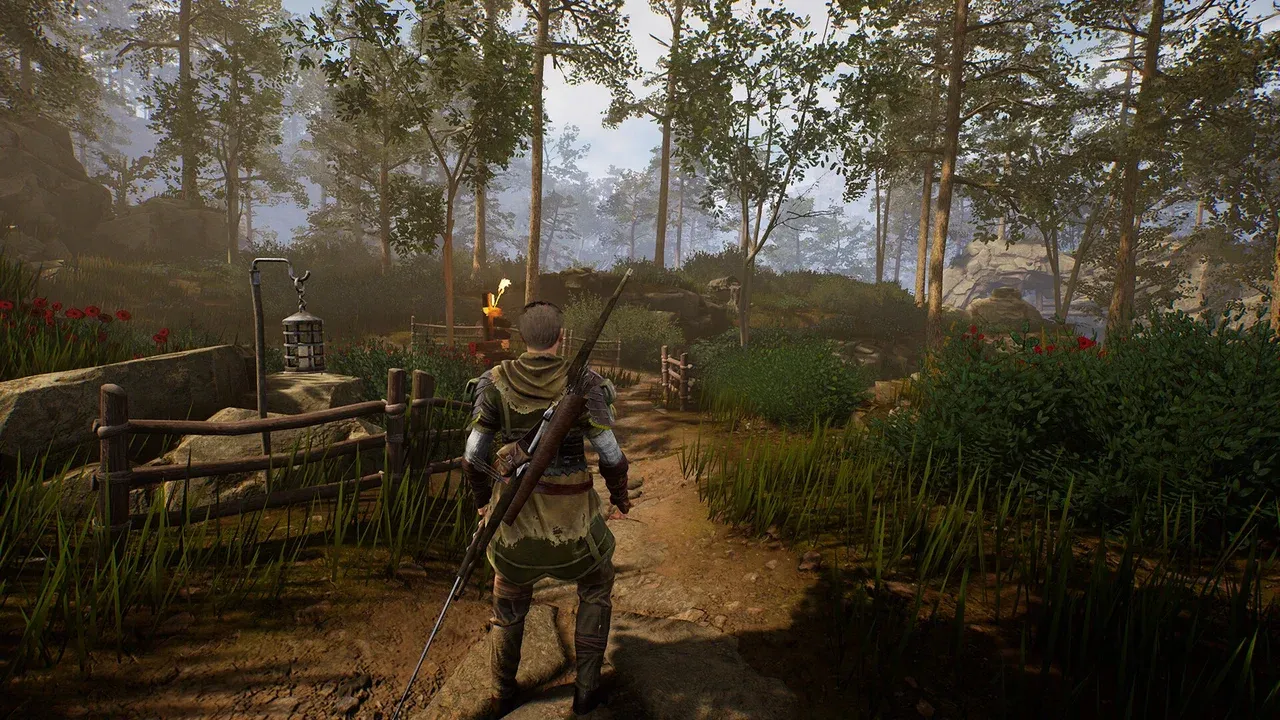
When I previewed Of Ash and Steel at Gamescom, I was enamored by its scope and mission statement. The opening area, which was demoed during the hands-on session, is still the most polished part of the experience. It is janky, but in a way you'd expect from a Gothic-inspired throwback.
But it's clear that the further you progress in the storyline, the more Of Ash and Steel reveals itself to be be a case of ambition over capability. A series of concessions where every statement boils down to a repetition of "yes, but".
Yes, it is moody and evocative, but also flat and shallow.
Yes, it's challenging, but at the cost of being vague and obtuse.
Yes, it's retro, but in the kind of way that feeds toxic nostalgia instead of celebrating the past.
 Joonatan Itkonen
There are good things in Of Ash and Steel. Some of them even promise of a better, more thoughtful game than what we currently have.
For example, the world of Grayshaft is a beautiful and densely packed sandbox that is genuinely fun to explore. The towns and villages feel like real places full of complex alleys and stunning art design that speak of history and lived lives better than most other low-fantasy games in this genre.
But they're also desolate in a way that betrays that mood every time you look closer. The sparse voice acting is another problem; speak to any two villagers and chances are they'll repeat the exact same bit of dialog.
Similarly, the skill and progression system has great ideas to its name, but it's the implementation that brings it down. You play as a cartographer thrust into a grand adventure well beyond your skills, and that sets the tone for the first dozen hours of the game.
Everything is locked behind a skill of some kind, be that crafting, survival, or warfare. At first, you can't even bandage yourself without help. Later on, you'll learn to craft potions and herbs that heal every wound and then some. Combat starts off clunky and jarring, only to open up into a world of varying styles depending on the chosen weapon.
In theory, it's an open and uniquely compelling mix of tropes and genre archetypes. In practise, none of it works because Of Ash and Steel doesn't bother to consider how long it takes to unlock skills or how the player experiences progression in the first place.
For example, I decided to pursue survival skills just to keep my character alive in the inhospitable world of Greyshaft. To do that, I had to increase my skills to a set level, one requiring three points more in dexterity and two for insight. Every level grants you three skill points to distribute, which mean I needed to gain two levels.
To gather experience, you can fight enemies, read books, do missions, scavenge, and loot. Fighting enemies was right out of the question, as without any skills in the relevant combat abilities or strength leads to basically an instant death. Missions are so vague that without any guiding markers or even a map they're pointless to pursue. Running off to explore a new part of the island leads to encounters with enemies of far higher levels and usually an instant death.
So, I spent two hours scavenging, reading whatever books I could find, and looting the same boring knick knacks that every house and settlement had in them. After a lot of grinding, I finally had enough points to unlock a skill.
Well, in theory, because to unlock a skill, you still need to find someone who will train you in that chosen field, and then you need to pay them for the luxury!
After much back and forth, I finally learned the first survival mechanic, only to realize it unlocked a marginal bit of the experience necessary to actually do anything. To learn more, I needed almost three times the experience to proceed.
This drip feeding of progression leads to a frustrating gameplay loop where it never feels like you're actually learning or getting better with the game itself. Instead, it's just an arduous slog to gather XP points in the hopes that you'll unlock a fractional improvement that's blocking you from another thing you truly need.
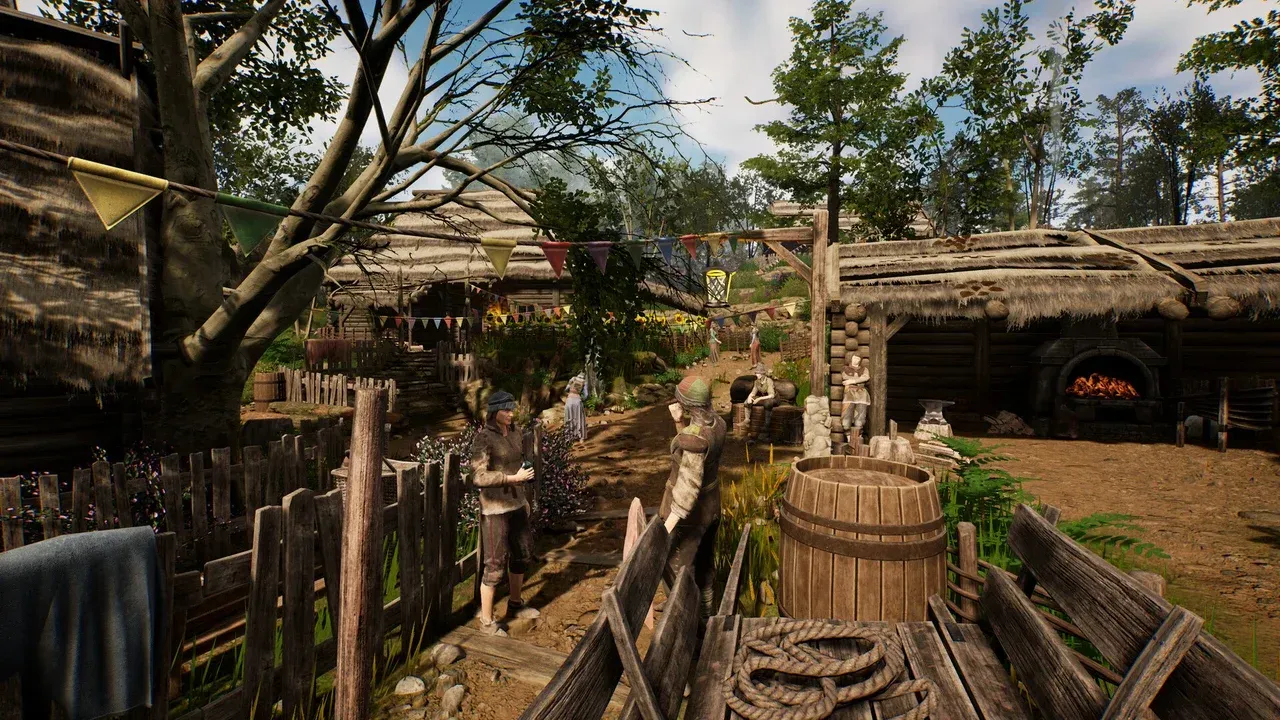
These same frustrations apply to the traversal and exploration mechanics as well. You can see the ambition and vision that Of Ash and Steel has, just as you can also see the limitations where the intention clashes with the developer's ability to make it a reality.
Despite being a cartographer, your main character doesn't have a map or anything resembling navigational equipment for much of the first half in the game. Instead, you're left exploring the wilderness based off contextual clues and NPC guidance, both of which are vague and wildly inconsistent in the first place.
Of Ash and Steel isn't the first game to try this immersive exploration, and you can clearly see its influences in the first few hours of wandering through Greyshaft. That opening area from the beach to the first city is easily the most polished part of the experience, except that's really not the kind of compliment you'd think it is.
I kept looking around for visual cues or indicators that would help in even suggesting a direction to follow, only to come up empty. Climbing a higher area is usually not a possibility, as Of Ash and Steel bumps against the limitations of its game engine that doesn't allow for much of a draw distance.
There are singular moments that impress. At one point, I spotted the looming spires of the city in the distance, which helped me orient my way towards the gates. But the further I played, the more it felt like a happy accident than intentional design.
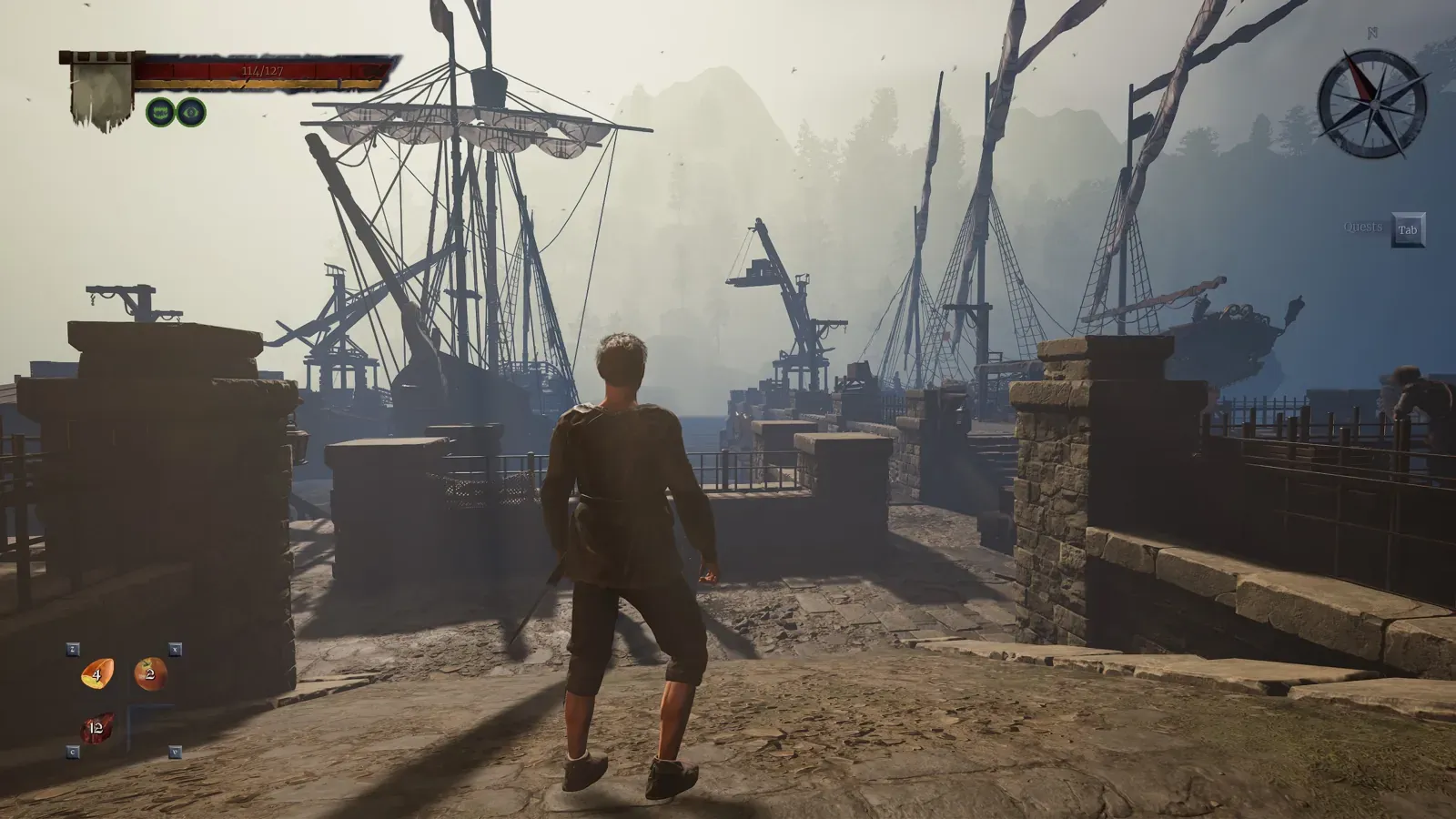
Of Ash and Steel is an odd experiment of deliberate jank that attemps to revive a nostalgia for a hugely specific sub-genre of RPG gaming.
The Gothic series, which Of Ash and Steel openly emulates, is beloved in certain parts of Europe. It helped establish the term of endearment "Eurojank", which lovingly embraces the unpolished and broken nature of the game because everything else is so ambitious and passionately made. In theory, that's precisely what Of Ash and Steel goes for as well.
But Gothic belongs to a certain era where these gameplay mechanics came from the limitations of the hardware and lack of design vocabulary. We were still figuring out what it meant to be a certain type of RPG in this space, which meant a certain level of clumsiness.
Today, a full two decades later, we've progressed to the point that a throwback means something akin to Kingdom Come: Deliverance 2 rather than a straight up revival of Gothic itself. And while it isn't fair for a straight comparison between the two on a technical level, even a passing glance at the design ethos reveals how limited Of Ash and Steel truly is.
I didn't hate my time with Of Ash and Steel, but I can't say for certain how much of my enjoyment is colored by my nostalgia for this genre. There were numerous occasions where I let notable issues go simply because they're expected out of a game like this. But as the problems piled up, I couldn't allow my fondness for jank blind me from the simple fact that Of Ash and Steel's issues are foundational rather than just technical.
This is a game that needs at least another year of polish and design before it's ready for prime time. It needs time to rethink its approach to the adventure and gameplay loop before it can address the host of game breaking bugs that pepper everything else.
There's a fun experience hiding somewhere in all of this, it's just nowhere near to finished just yet. Dedicated fans yearning for a return to the days of Gothic may find pleasures in its inscrutable mechanics and gameplay that fights the player at every turn. Modders might even make it a more rewarding experience before the developers do.
But for everyone else, Of Ash and Steel is an unfortunate example of ambition missing the delivery. It swings big and I admire it for that. Perhaps in a year or two, it will surprise us all.