Distributor provided a review copy
Most won't remember, but there was a time in the 90s and early 2000s when videogame mascots were the thing. Everyone needed to have fun, and if you didn't, well, you were out of the cool kids gang.
A lot of that had to do with Nintendo leading the way. They had Mario and his entire gang of friends who were so instantly iconic that everyone, even those who didn't game, could recognize them. SEGA responded accordingly with the creation of Sonic, modeled after Bill Clinton of all people, who became an icon in his own right. Meanwhile, Sony, the new kid on the block with their powerful but untested PlayStation console, had nobody.
Credit where credit is due, Sony tried hard to find a mascot. Most will probably say that Crash Bandicoot is the unofficial mascot of the console, but few mascots were as quickly abandoned as he – especially as he's now basically owned by Microsoft. Then there was Spyro, who made a splash with three well-received games, but disappeared pretty quickly as well. Does anyone remember Gex the Gecko? No? Probably for the best.
In between the bigger titles there was Whoopee Camp, a small Japanese developer founded by legendary game designer Tokuro Fujiwara, who in the past had created titles such as Mega Man and Ghosts'n'Goblins. He had a vision for a new platformer featuring a pink-haired hero called Tomba, a wild jungle boy in a constant battle with evil pigs seeking to dominate the land.
The first Tomba was a traditional side-scroller adventure with very light RPG mechanics. To date, it is one of my favorite games on the PlayStation thanks to its impeccable charm, fantastic soundtrack, and smart level design. It was a critical darling, but sold poorly, so Fujiwara and his team pivoted hard for the sequel. Released in 1999, Tomba 2 turned into a full 3D platformer with an even greater emphasis on skill-based outfits, weapons, and a semi-open world to explore. For its time, it was immensely ambitious, especially considering the hardware limitations.
Like Tomba, it was met with critical acclaim and sold a handful of copies. Whoopee Camp shut down just a year later. Now, 25 years later, thanks to Limited Run Games, we get a chance to relive the adventure all over again, and it's wild how well it has aged.
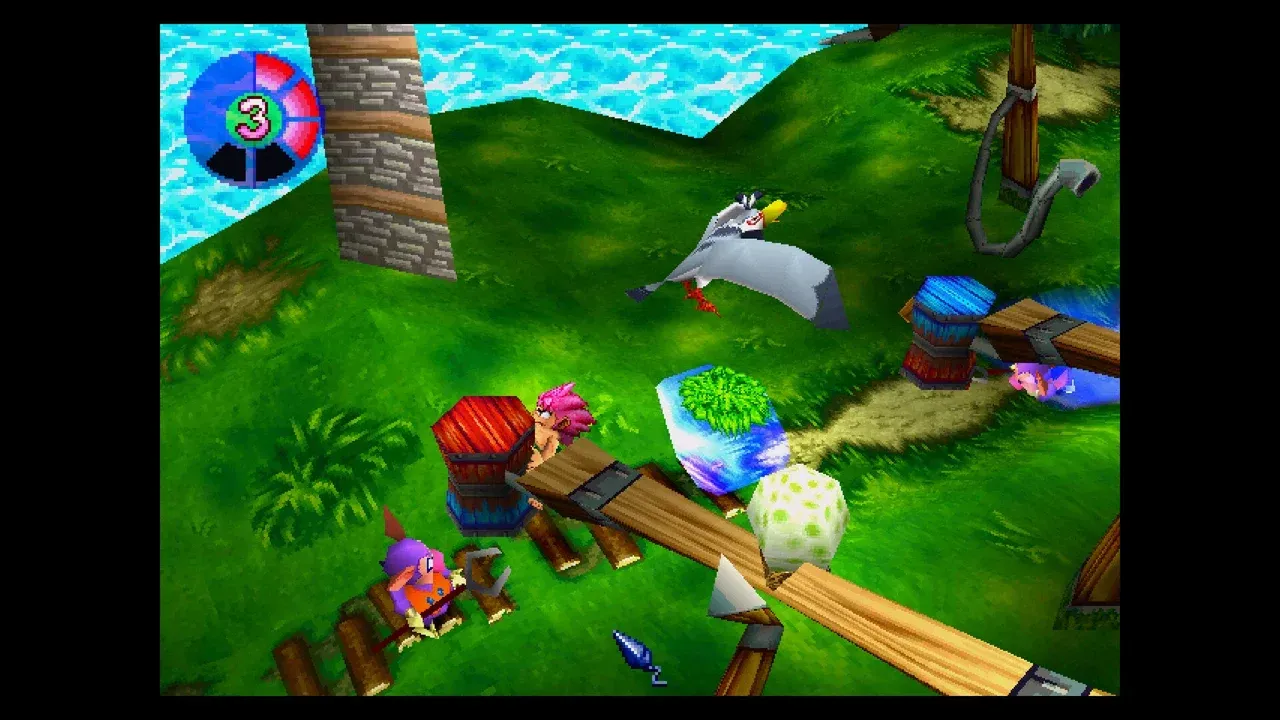
Tomba 2 is a sequel that doesn't require you to play the original, though it does feature an assortment of callbacks and inside jokes for dedicated fans. The humor is still so absurd and anarchic that most of the time it's hard to tell what is an Easter egg and what is just a random bit of fun. Which is part of the charm. This is a world that exists in a childlike logic where anything can and probably will happen.
The plot is as straightforward as it is silly. Tomba travels to a new continent to look for his missing friend, who it turns out is now is prisoner to the evil pigs. To free them, Tomba must once again locate the Evil Pig Bags harnessing the power to dispel curses, and free the land from the magic that has turned it upside down.
On the road, Tomba meets both strangers and familiar faces, all of whom need his help in some way or another. These range from finding a hungry monkey some bananas (and cooking them just right) to fixing broken valves in a coal mining town located in the heart of a volcano. In traditional 90s fashion, some of these quests are easily parsed with a clear goal to follow, while others are downright inscrutable by modern standards. A character might give only the vaguest hint about a desire at the start of the game and it's up to the player to remember that they needed a specific item which can only be found towards the very end.
But that's part of the fun, and it's lovely to see that Limited Run Games hasn't tampered with the mechanics one bit. Instead, as with their previous releases, this is as thoughtful a restoration as you could want. The only quality of life improvements are entirely optional and accessed through the menu, where you can save at any time and rewind the game to take back the occasional misstep. Everything else is just as you remembered it, right down to the option to add a CRT filter to make the game look era-accurate.
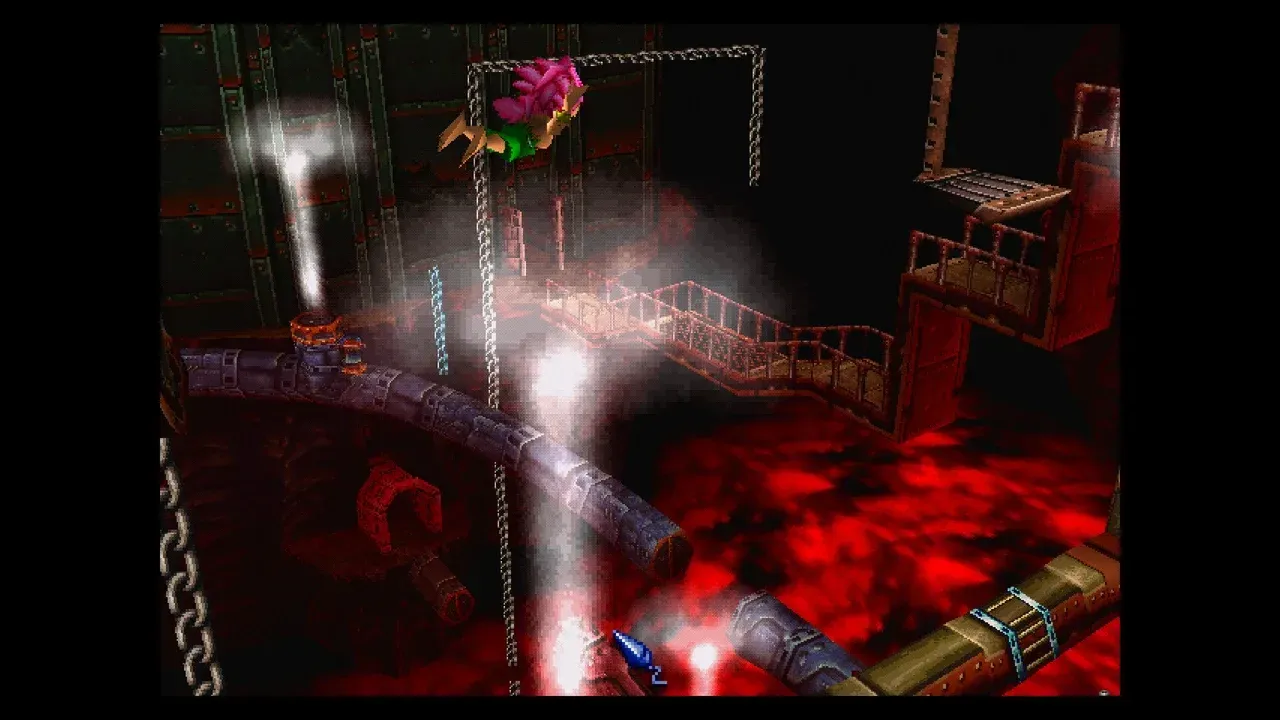
While the visuals are a bit sharper than in the original, I can't say that Limited Run Games has done anything to the controls. The game runs at a delightful 60 frames per second, which is a step up from what the original PlayStation could muster. That alone makes platforming easier and more palatable, but it's clear that this is a product from the era still finding its footing when it comes to 3D worlds.
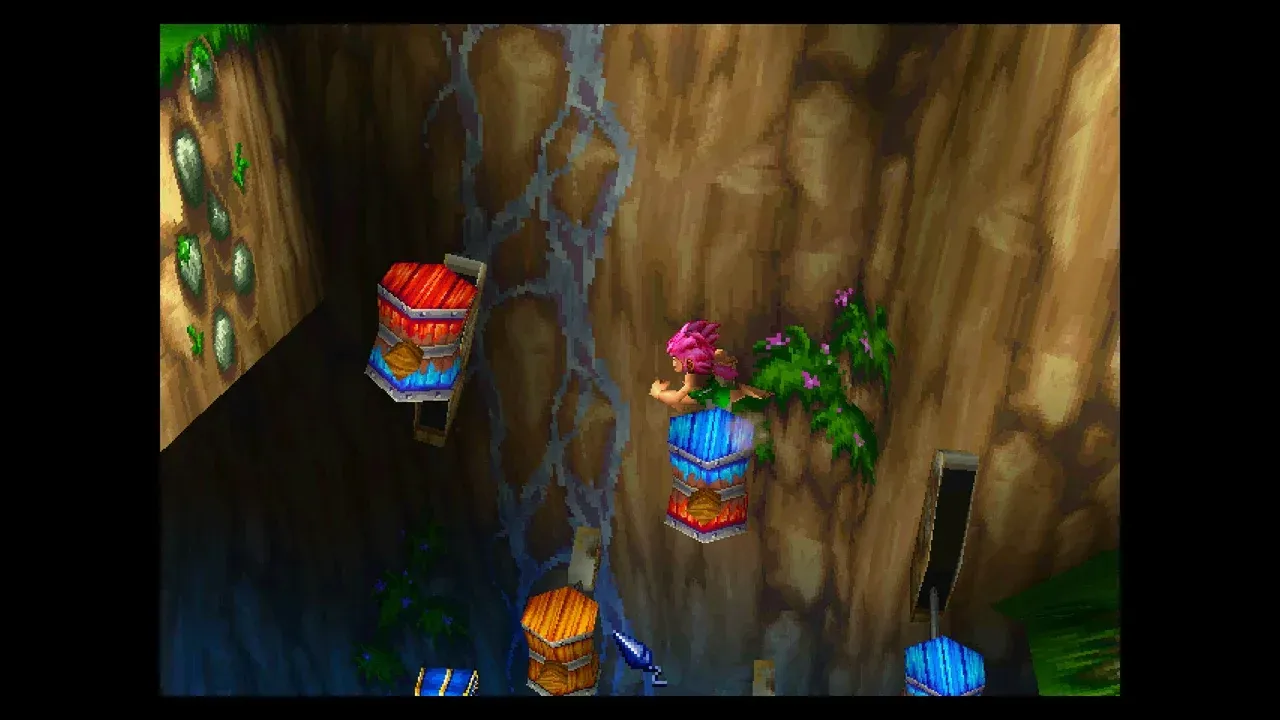
Some of the jumping sections, especially when the camera moves around the imaginative world, are a real pain in the ass. There's no other way to put it. Tomba is a slippery rascal, and there are numerous situations where he will slide off a section that he shouldn't. It's frustrating and leads to cases where the rewind button comes useful more than once.
But that's part of the appeal in a way. If this were a remake, we'd expect tighter controls and an updated world, but that wouldn't be Tomba anymore. It would be something else reminiscent of it. A great remaster – or a loving port like this one – should be judged on how well it preserves the original, and Limited Run Games has succeeded in spades here once again.
If there is something to complain about, it's how Limited Run Games operates regarding physical media. Preservation is vitally important to the games industry, which still acts like the film industry did a hundred years ago. Nothing is restored or kept for future generations. Physical copies remain the exception, not the rule, and that's the case with Limited Run Games as well.
At the time of writing, every edition of the physical copies for Tomba are sold out. Only scalper copies, which go for hundreds of Euros, exist on the market. You can get a digital copy, but we already know how precarious the idea of digital content ownership truly is.
In a better world, Tomba would exist on the shelves as a regular copy that is easily purchased for fans everywhere. Until that happens, we're stuck with a halfway measure that simply isn't good enough.
It's a peripheral complaint, but one tied to the essence of game conversation. Limited Run Games does incredible work when it comes to keeping games alive for modern standards. I wish their physical printing would catch up.