
Blade Runner 2099 review: a thrilling, smart sequel to an iconic story
Against all odds, Blade Runner 2099 is one of the most unexpectedly great series this year.
Region Free rating
Philip K. Dick's original novel, Do Androids Dream of Electric Sheep?, did not include the term Blade Runner.
The term came from an unrelated novel by Allan E. Nourse, which was in turn adapted into a script by William S. Burroughs. The original screenwriter hired for the project, Hampton Francher, liked the name so much that producer Michael Deeley optioned the rights to Nourse's novel just to use it in their film.
Over the decades, Ridley Scott's film adaptation became so ingrained in pop culture that today many still claim it was always part of the lore – or that there ever was a singular, unified lore to begin with. Even Roy Batty, iconically played by Rutger Hauer, was entirely different in the novel than he was on screen.
Today, the view of what cyberpunk is or can be has grown limited and regressive. Its fanbase is a collection of aging, nostalgia-craving men terrified at the thought of their sandbox ever changing. Everything leads back to Scott's film and nowhere else; not the book that spawned it and certainly not any realm beyond. Blade Runner has to exist in an eternally repeating vanity record like one of the Tyrell Corporation's memory implants.
Thankfully, Blade Runner 2099 bravely ignores all that and explores and reinforces the themes of Dick's original work with curiosity, bravado, and maturity that anyone who truly cares about the cyberpunk genre should celebrate.
Set 50 years after Blade Runner 2049 and 80 years after Scott's original, Blade Runner 2099 returns to Los Angeles after a war between Replicants and humans has left the Replicants in control of the planet. Humans, despite spending a near-century in horrific conditions under the tyranny of the Tyrell Corporation and ecocide, can't abide the thought of their property turning on them. The planet may have been a stinking death trap, but it was theirs.
Meanwhile, the Replicants, with their limited lifespans, continue their own journey on what it means to live – if anyone really does. In a defiant move, some have formed their own special police squads and taken the name Blade Runners to instill in humans the same fear their predecessors felt. Perhaps vindictiveness is a sign of humanity itself, the series argues.
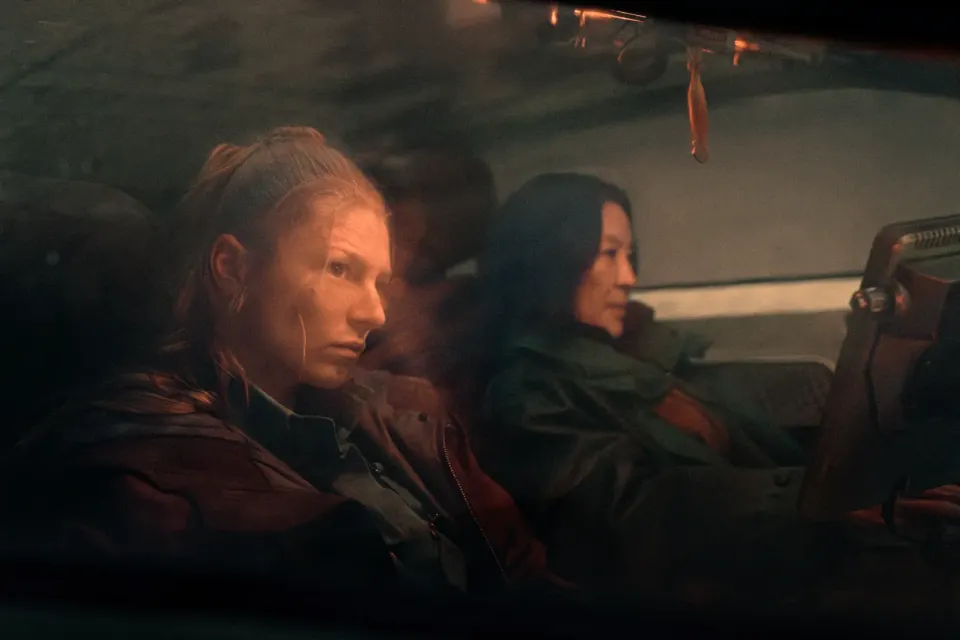
In the slums, Cora (Hunter Schafer) dreams of taking her invalid brother off-world. To do that, she needs access to a shuttle, and nothing comes free, even as humans claim to stick together. After a desperate escape from Replicant hunters, Cora undergoes a dangerous procedure to implant artificial parts inside her to blend in with the Blade Runner units. Somewhere in their confiscated libraries is an artefact that could shift the power balance once again – a memory of a memory.
Cora is partnered with the dying Olwen (Michelle Yeoh), who nears the end of her artificial life cycle. She was once an off-world Replicant who has seen the stars, or so she remembers, and that memory reminds her of her place in this world.
But is a memory a lie if it's all you have? Olwen knows some of her memories are implants, but they are hers, and that gives her a soul. Cora's are entwined with her trauma, and she'd forget them if she could. What does that make her? Blade Runner 2099 is a story of contradictions and unknowable mysteries about who we are and what we make of ourselves.
Schafer is brilliant as Cora, the human hiding amongst the Replicants. She has to play conflict, anger, mechanised composure, and artifice yearning to be real all at once, and she's mesmerizing every single minute. Yeoh makes the most of her composed, stoic screen presence, but gives Olwen an unexpected, tender edge as a Replicant who refuses to process this newfound fear in the face of certain death.
Together, they play off each other beautifully, each one measuring up the other with every word and tick. They both know the other is hiding something, but since both have something to lose, they keep going to see where all this ends up.
Blade Runner 2099 uses sunlight the way Ridley Scott's Blade Runner used darkness and Villeneuve's neon. Each has their own version of chiaroscuro to create variations of the same world in different states of its afterlife. For Scott, it was the hyper-capitalist masochism right after the deluge; Villeneuve, the near-pornographic coddling of men in soothing holograms of mothers you could fuck.
In Blade Runner 2099, the world itself tries to move on, and none of its occupants will let it. It's a society where history can't be made again, because no one can dream anymore. Instead, everyone chases implanted memories, and those who own the fragments of nostalgia control the future. Around them, the planet wakes to a blinding sunrise, revealing the aftermath of war and subjugation. What does a place like that look like in the daylight, and can anyone bear to see it?
As with the best cyberpunk stories, Blade Runner 2099 is as much about our time as it is about what comes next. Legacy corporations are gone in name only, now rebranded as a vague facsimile meant to instil nostalgia even if the customer doesn't know it. There is more than a little irony in the fact that the series is an Amazon production.
Where Blade Runner was about death, and 2049 about legacy, 2099 is all about birth. The Replicants see the limits of their lives just as humanity sees the enforced boundaries on theirs. Both desire more, and both refuse to budge an inch for the other.
Showrunner Silka Luisa expands the mythology and worldbuilding to fascinating new places, and each new frontier feels like a natural continuation of what came before. This is a living, breathing world, and in true noir fashion, it has all the opportunities for something better, but is unable to move on from its own dark places.
The soundtrack by Leo Ross is a daring, inventive mix of old and new. A wailing death song of the old world, with synths and saxophones gasping for air, overtaken by the vibrant beat of modern genres rebuilding over the past. Like the rest of the series, it is invigorating, bold, and rewarding.
At eight episodes and just under as many hours in length, Blade Runner 2099 dips slightly midway through, as it almost loses focus on its main thread. It's not an unwelcome detour, as the world and characters are so deeply fascinating, but I do wish this were either a feature film or a longer series. Nonetheless, by the time it reaches its thrilling, poetic conclusion, Blade Runner 2099 more than makes up for any missteps.
Like its predecessors, it's a one-off story with a clear beginning and end, which makes it all the more compelling. There are no loose ends, and it's wonderful to watch something this assured of the story it wants to tell.
Against all odds, Blade Runner 2099 is one of the most unexpectedly great series this year. It is a smart and thrilling continuation of an iconic cyberpunk vision that boldly takes the next leap in a conversation half a century in the making.