
Once Upon a Time in the Middle East is an unexpected masterpiece
Once Upon a Time in the Middle East is an elegant, old-fashioned plea for decency, and it made me cry more than once with both sorrow and joy. I think it will do the same for anyone who sees it, and everyone should.
Region Free rating
China's Oscar nominee and a massive box-office hit back home, Once Upon a Time in the Middle East has already charmed audiences on a global scale, yet for whatever reason it flew under my radar until a screener arrived in my inbox.
I'm glad it did: Once Upon a Time in the Middle East is one of the best films I've seen this year. It is an immensely humane, richly textured work of anti-war cinema as savory and intricate as a hearty meal. But be warned: despite its warm and playful advertising, this is not a film for the faint of heart, as it depicts war in all its monstrosity and awfulness without ever looking away.
Told in retrospect, Once Upon a Time in the Middle East opens on an aging chef returning to the fictional city of Bahata. He once worked there before the war, but that was decades and another life ago. His papers tell the story of a suspicious character with ties to terrorist acts and long stretches in custody for both warring sides. The truth, it turns out, is both simpler and more complex, just as any life.
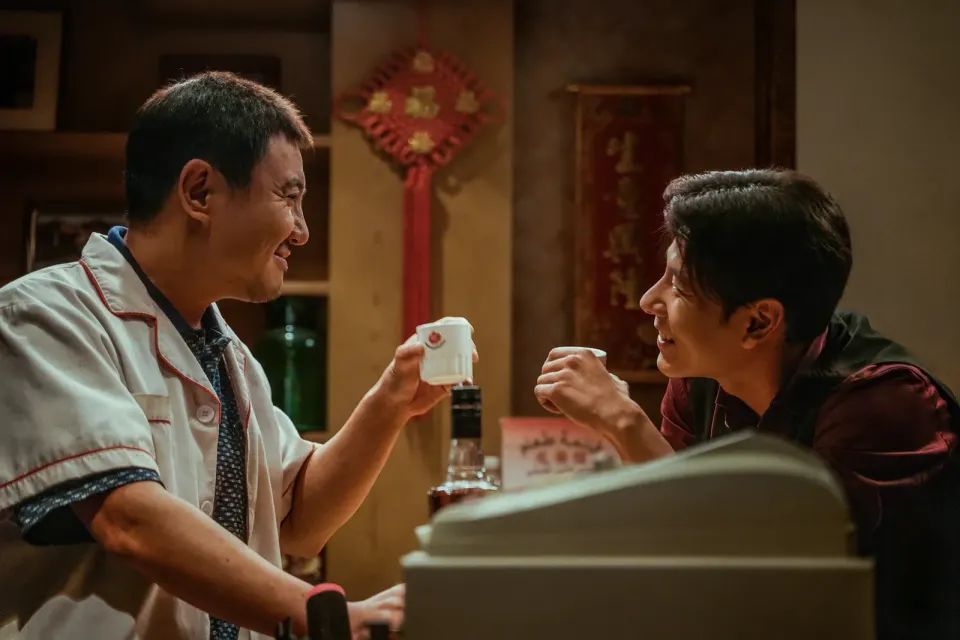
The man is Xu Fu (Shen Teng), who arrives in Bahata to repay a debt after a workplace accident left him unemployable anywhere else. He becomes the head chef at Loong Restaurant, a crummy kitchen that serves bad amalgamations of Chinese food to an audience with neither care nor appreciation for it.
Xu's closest friend, Ma Junsheng (Jiang Qiming), works the floor and understands the locals. They form a tenuous agreement with Zaid (Sherif Sobhy), whose daughter has cancer. For him, the restaurant is the means to pay for her treatment. There is mutual benefit to the deal, even if neither side fully trusts the other.
Then, one day, war arrives in Bahata. It was always in the background, and now it is everywhere. Xu, Ma, and Zaid try their best to cope with the circumstances, until children orphaned by the shelling find their way to the restaurant. Then soldiers, both American and otherwise. Finally, violence follows.
For nearly three hours, writer/director Wen Muye masterfully weaves a grand tapestry of tragedy and triumph, as Xu grows from the cold and distant survivor into someone who realizes there are no greater joys in life than good food and helping others. But in a world hell-bent on destroying itself, that kind of idealism may not be enough.
Muye's film exists in the same grand tradition as Giuseppe Tornatore's sublime The Legend of 1900 and Jean-Pierre Jeunet's masterpiece, A Very Long Engagement. Films that depict horrendous events with grace and optimism, even as they acknowledge that certain wrongs can never be put right. They exist in a realm of magical realism out of necessity. Some of the events are so brutal, so inhumane, that without an escape, they would be too horrific to repeat.
In the wrong hands, such a delicate balance could easily come off as flippant, reductive, and gross. There is no whimsical way to frame the countless deaths of innocents, especially children. Muye understands this, and his camera never flinches when the worst happens. Death is ugly, brutal, and pointless. It leaves a stain that never washes off. There are moments in Once Upon a Time in the Middle East that left me gasping for air with an aching pain in my chest. Muye's great compassion is that he allows us a reprieve, even if it is bittersweet.
His cast, especially the leading duo of Teng and Qiming, is a wonderful collection of actors who were unfamiliar to me. Now, I must see everything they've done before. They bring gravitas and realism to every moment, especially those quiet, simple beats that reveal how easily humans can overcome their differences in the right circumstances, and how rarely those circumstances ever manifest.
I'm mesmerized by Sherif Sobhy, who plays Zaid, for his tremendous work in an increasingly complex role. For decades, American cinema has painted this part of the world with one broad, ugly brush with no tolerance for nuance. In Sobhy's hands, Zaid is a fully-realized person whose hopes and dreams are corrupted by a cruel and uncaring world. Neither Muye nor Sobhy condone his actions, nor should we, but the film does ask us to understand how easily these things come to pass.
This is a beautiful, haunting, and complex film told with great simplicity. Like the best novelists, Muye understands his story doesn't need the extra flourish. All the ingredients work in harmony, and it is best served plainly and without fanfare. Once Upon a Time in the Middle East is an elegant, old-fashioned plea for decency, and it made me cry more than once with both sorrow and joy. I think it will do the same for anyone who sees it, and everyone should.