
Primetime review: Robert Pattinson stuns in Lance Oppenheim's blistering drama
Robert Pattinson is stunning in a hyper-subjective dramatization of real events that is nauseating and thrilling all at once, even if it remains distant and shallow.
Region Free rating
There's a moment in Primetime, the first narrative feature from Lance Oppenheim, where Robert Pattinson does something I haven't seen another actor do since the days of Lon Chaney.
The stunning moment comes around the halfway mark, where Hansen learns his show will occupy the biggest slot on late-night TV. With no competition around, his vision of justice will dominate the airwaves and the attention of the entire country.
His newly hired canary, Daniel (Skyler Gisondo), tries to make nice and talk about the work as if it were something they can file away at the end of the day. He asks Hansen whether his bracelet is a grounding device for his performance. Hansen freezes, and for a moment, it looks like there's another person inside Pattinson trying to get out. His skin crawls, his eyes dart as if looking for an exit for the soul, and for a split second it looks like he might devour Daniel whole.
Then, Hansen swallows as if forcing back bile in the shape of a person, and his entire musculature relaxes into a practiced gait. A wild animal that realizes it has an audience. He smiles: "It's not a performance," he says, and believes it.
It lasts for two seconds, but it changes the tone entirely. Like we had just lost cabin pressure for good. While the rest of the film is a bit bigger and broader, it all hangs on this one turn, and Pattinson sells it perfectly. He is Hansen, and Hansen is someone else, perhaps someone even he doesn't know, and Pattinson is all these things in total balance. It ranks among the great horror performances of all time.
Pattinson's version of Chris Hansen, the host of the early-2000s reality TV series To Catch a Predator, is fictionalized. But as with the show it portrays, how much remains up for debate. Hansen has been vocal about his distaste for Oppenheim's film, calling it a dishonest portrait of himself and the show.
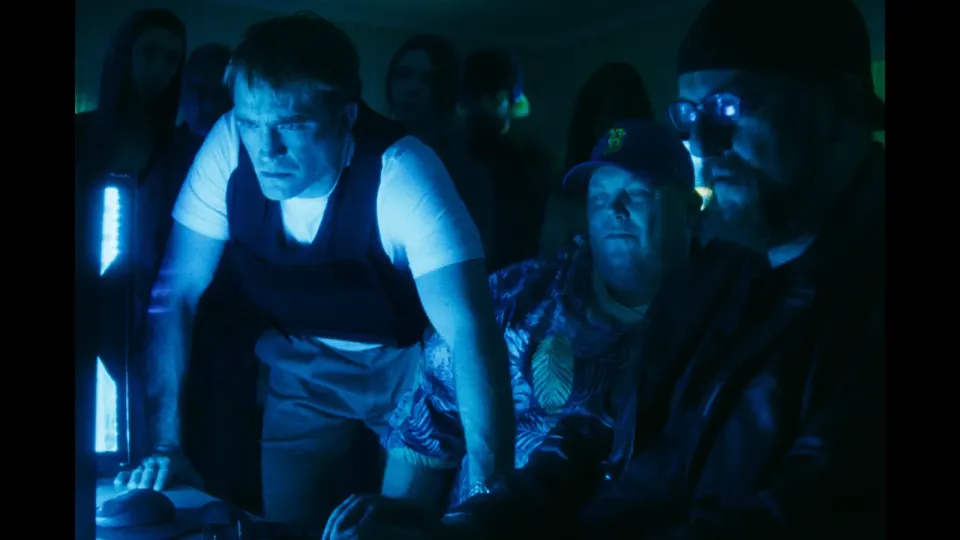
In a way, that's not entirely inaccurate. Primetime isn't interested in facts, but in emotional truth, and that's a far murkier subject to tackle. To accomplish this, Primetime uses four cameras to toy with audience perception: Mini-DV, the revolutionary device from the early 2000s, puts us inside the show; a broadcast model tube camera shows the subjective mind of a person; the ARRI Alexa is "reality"; and a medical camera breaks all logic when Hansen dives into his fever dream of bagging his biggest catch.
This means Primetime is all about manipulation and controlling the narrative. Its version of Hansen and the events is Oppenheim's emotional connection to material that had already peaked by the time he was ten years old. If Primetime even insinuated that it was anything but hugely subjective, it would be a problem. But from the first frame onwards, it's clear this isn't the case. Oppenheim's smart filmmaking keeps us on our toes and forces the viewer to question their relationship with the image at every turn.
The backbone of the film is the 2007 Esquire article "Tonight on Dateline This Man Will Die", about the suicide of Bill Conradt (played in the film by Alex Winter). Conradt was an assistant district attorney of Rockwall County in Texas, who killed himself on camera when Hansen's crew and the police rushed in to capture him. Primetime focuses on the months leading to the event and the immediate aftermath. Almost everything else, apart from the cracks in Hansen's private and public personas, is noise.
Primetime is a justifiably angry film, and it expertly tears apart Dateline's bloodlust and ethical failures. Oppenheim's past as a documentarian shines in his elliptical storytelling, where entire scenes will skip sections, lines, or anticipated turns to tighten the narrative. The audience has to infer and read into the subtext, such as the shifting camera technology, to keep up. The skewed color spectrum and aggressively askew angles heighten both absurdity and unease, which further elevate our anxiety and response to the content.
If that sounds familiar, it's because these are similar to the methods weaponized by Reality TV in the past decades. Their purpose is to elicit the strongest response in the shortest amount of time. After all, you might click away otherwise.
As a result, Primetime is a visceral and tough viewing experience, but it achieves that at the cost of depth. Apart from quick asides, like where Hansen's producer, Andie (Merritt Wever), considers jumping ship to another show copying Hansen's questionable tactics, we rarely get a sense of just how culturally pervasive the show or its effects were. Even if it lasted a mere three years, Hansen's work was promoted and championed by everyone from Oprah to Jon Stewart. Today, most would pretend that never happened.
By highlighting the strangeness and sleaziness of Hansen's production, Primetime risks making it unique or an outlier. The most horrifying part of all this is that it isn't. In fact, by today's standards, 2000s television is downright quaint. Portraying the past as a lurid DV-hellscape distances us from it in a way that we can shut it off and not question any of it further. We might feel dirty and complicit in the moment, but like a haunted house ride, that feeling washes away eventually. I'm not sure it should.