Rooster is a coming-of-age dramedy set in a sleepy liberal arts college town, where people in different states of arrested development learn the mysteries of love and adulthood. These people just happen to be in their late 50s.
Much of the series is already familiar before it even begins. Like so many of the other stories about the refusal to grow up, Rooster is fascinated by the fantasy of reclaiming parts of youth that have slipped away. It continues the long tradition of college as a kind of Neverland, allowing you to relive every carefree memory with the benefits of hindsight.
But where similar concepts settled for a repeat of endless parties and questionable morality, Rooster's strength lies in its melancholy. It knows you can't go back, not really, and every attempt to do so is vanity. So it gently, but with great empathy, pushes back on established tropes and expectations. In a way, it has more in common with La Belle Époque, a film I dearly love, than with Old School, a film I really don't.
 Joonatan Itkonen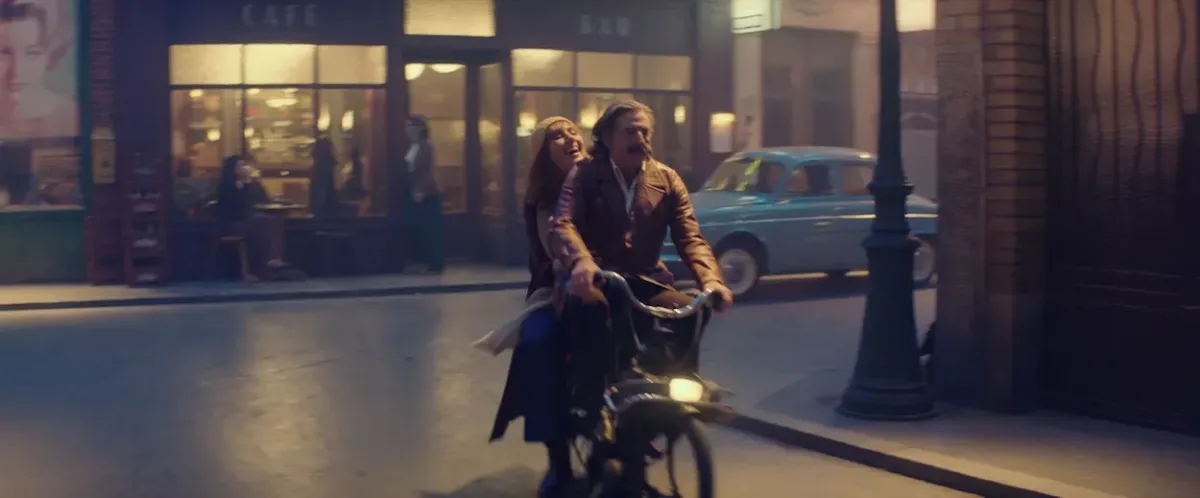
Yet for all its smarts, Rooster isn't here to subvert anything. It still hits the beats you'd want out of a breezy comedy from Bill Lawrence, the creator of perennial favorites like Scrubs, Ted Lasso, and Shrinking. In an ideal world, it would occupy the evening slot on a Friday, right before the late-night shows kick in.
Steve Carell plays Greg, a reasonably famous and successful author stuck in a stasis ever since his marriage fell apart. He's wealthy, handsome, and consistently perplexed by the notion that at some point, without warning, he got old. It's not like he wants to sit around smoking weed and playing Xbox all day, but there's a perpetual sense that he missed out on something important.
His daughter, Katie (a tremendous Charly Clive), is a teacher. She's in her thirties and, at least superficially, has her life in better order than he does. But when Katie's husband, Archie (Phil Dunster, endlessly punchable), cheats on her with a grad student, everything comes tumbling down. Not least because Katie accidentally, but not quite, burns Archie's house down.
Cajoled into a temporary teaching assignment by the needy dean, Walter (John C. McGinley, always a gem), Greg finds himself in the middle of a life he never got to experience. For him, college was a distant dream that he lived through his books and alter ego, the eponymous Rooster.
It doesn't help that his vision of college exists in the same dreamy, nostalgic landscape that was never truly real, even if Walter believes in the same fantasy.
At first, Rooster has a few too many red flags about this type of humor. There's the snooty teenage girl who questions Greg about his treatment of women in his books. Another complains about pronouns. There are complaints about feelings and how brittle everyone is.
You know, the kind of stuff that only bothers the people who complain about how sensitive the world has become.
Luckily, as if aware of the tightrope, Rooster turns it around. The joke is always squarely on Greg and Walter, who in turn seem aware of just how badly they've fallen off the wagon. Instead of complaining about it, at least too much, they roll with the punches and make the most of it. Similarly, the students themselves prove messy, complex, and immensely human. For a genre that deals in caricature, Rooster is often disarmingly poignant in its observations.
Walter might be a relic, but watch how quickly McGinley gives him texture and depth. He's a man afraid of time and his aging body, destined to work with eternal youth in waves that come and go as often as the seasons. It's a tremendous showcase of McGinley's innate ability to break hearts just as easily as he gets laughs.
Then there's Danielle Deadwyler, who plays Dylan, the poetry teacher who befriends Greg against her better judgment. Already one of the great dramatic talents of our time, Deadwyler proves she's also painfully, hysterically funny. Her role as both a straight man and a delightful source of acerbic banter gives the series a kick of energy every time she's on screen.
Last, but definitely not least, is Annie Mumolo as Cristle, Walter's assistant. Like the scene-stealing Janitor from Scrubs, Mumolo's Cristle appears usually in the background, but often runs away with entire sequences.
At ten episodes, six sent for review, Rooster's spends a lot of time on pure setup. By the halfway point, it's still figuring itself out. In a way, such a traditional buildup feels nice and nostalgic—a reminder of simpler, better times. But it does raise concerns about how rapidly it has to tie things together by the end, and how long we'll have to wait for a second season, especially with Carell playing coy about his reluctance to pursue another long stint on TV.
If such meta-concerns do not bother you, Rooster deserves more than a warm recommendation. It's further proof that Lawrence is the rightful heir to Norman Lear, the television icon who once defined the cultural landscape of deeply humanistic comedy.
Lawrence carries that same torch with great malleability, moving from hospitals to football pitches and now to colleges to tell stories that touch on the innate truths of who we are. There's great comfort in that.