
Above the Line is an oddly bitter yet loosely playful satire about Hollywood
An unpolished, rough little gem that, while painfully clear about its inspirations, has enough gas in the tank to get where it's going on its own terms.
Region Free rating
When Pulp Fiction came out in 1994, it gave birth to an entire cottage industry of Tarantino clones. For years, both good and bad indie productions mimicked a formula that Tarantino himself lifted from the French New Wave, eventually leading to the shorthand of "Tarantinoesque", which itself became a lazy dismissal of anything with self-referential dialogue and non-traditional formatting.
These days, calling something Tarantinoesque rarely means anything, as Tarantino himself has evolved into a different kind of filmmaker, and the time-hopping narrative structure is so worn out that even TikTokers use it ironically.
So imagine my frustration, looking back at my notes for Above the Line, when I discovered scribbled in the outer edges the words: Tarantinoesque, Shane Black-y, Tony Scott-y. Shorthand after shorthand to describe a film about the dangers of that shortsightedness.
I don't want to write Above the Line off so dismissively. That's not what the term is for, after all. But it's been some time- at least well over a decade- since I've come across a film that so brazenly lifts from such known sources, and does so with just enough self-awareness that it almost gets away with it.
To use another, equally unhelpful shorthand, Above the Line is what happens when Tarantinoesque meets Altmanesque, as the two see each other across the bar and like their vibe. Confused yet? You should be. I know I was.
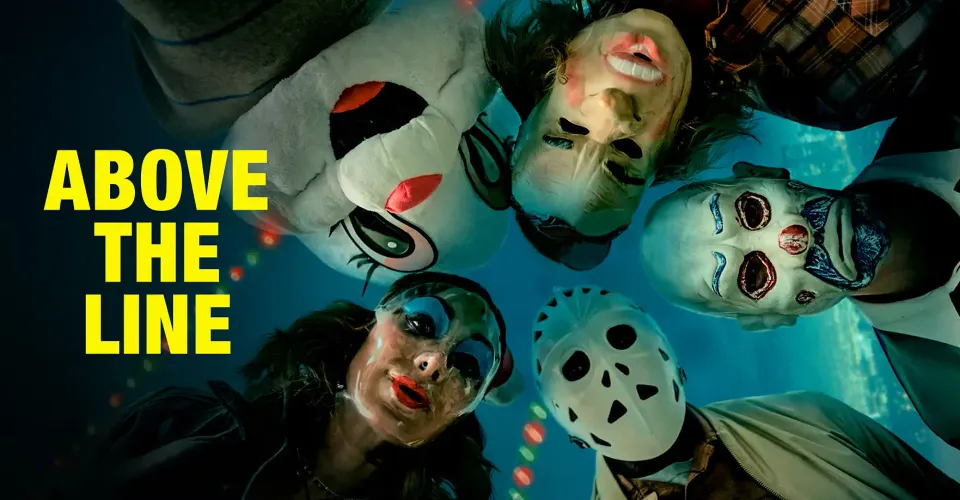
Above the Line begins with a group of strangers, all Hollywood hopefuls, receiving a letter with an unorthodox offer just around Christmas. Like most things for people at this halfway point into what they perceive as "the inner circle" of Hollywood, the offer is laced with uncertainty and not a little suspicion. The packet contains $1000, a code name, and instructions to arrive at the dead of night in the Hollywood Hills. Upon arrival, the six wannabes discover they all have a part to play in an elaborate theft of prized award statues from a famed producer, and there's little endgame in sight beyond a quick payday and petty malice after years of eating dirt.
From there, Above the Line unfolds as a meta-narrative heaped upon another one, and how much you get out of it depends entirely on your tolerance for self-awareness in any storytelling, not just with Hollywood. The producer is a thinly disguised Harvey Weinstein stand-in, the studio name-drops come fast and furious, an entire bit of dialog calls attention to the Shane Black-ness of it all, and several plot twists get called out for what they are, which consistently teeters on this side of intolerable.
Around the halfway mark, I began to ask myself whether or not I was hate-watching this or genuinely engaged with the material. To the film's credit, by the end I cared about the conclusion. How? I'm still uncertain, but perhaps that's part of the charm. There's a looseness to the direction from co-writer and director Jeffrey Scott Collins, which makes even the most contrived reference go down more easily. For example, a potentially deeply mean-spirited gag involving one of the unlucky thieves wouldn't work if the tone was even an inch wrong-footed.
The casting certainly helps, with a consistently charming roster of character actors lighting up even the direst bit of dialog, from Letterkenny favorites like Dylan Playfair to Sophia Ali, who was a highlight in the otherwise dire Uncharted adaptation. TV veteran Gregg Henry is deliciously sordid as the Weinstein-lite target of the crime, giving us a perfect lightning rod to distract from the fact that everyone is more or less a bad guy on screen.
The multi-act structure and hopping between viewpoints and timelines get out of hand towards the end, and there's one particularly frustrating rug-pull in the third act the film could do without, but looking back on the big picture, it's remarkable how self-assured Above the Line is, especially when it bites the hand that feeds. This is a film that wants to be part of the club that it takes the piss out of, and that double act sort of, almost, nearly works.
Which leads to the admiration, even if it goes hand in hand with befuddlement. The actual heist is a lot of fun, the direction of all actors is solid, and Collins has an innate understanding of comedic timing, especially when the gags are pitch-black in tone. Put those together, and the resulting stew is an acquired taste, both broadly seasoned with familiar favorites yet oddly bitter to boot. It's easy to recommend because you can tell the people behind it are talented, but it's equally difficult to recommend wholeheartedly without plenty of disclaimers for all the baggage it knowingly brings to the mix.
But in all fairness, I haven't stopped thinking about it since I first saw it a few months ago, and it's more than once found its way into the conversation about underseen films that have come out this year.
Back in the days of Blockbuster and other video rental stores, Above the Line would have found a healthy second life as the favorite of your trusted clerk. An unpolished, rough little gem that, while painfully clear about its inspirations, has enough gas in the tank to get where it's going on its own terms. That's not nothing.