
Upiro review: Lovecraftian Spanish horror breathes new life into vampire cinema
Beautifully written and directed, Upiro is a mesmerizing historic epic that upends all expectations of traditional vampire films.
Region Free rating
The grand obstacles with vampire cinema are the same as they are with historical fiction: by now, we've heard most of these stories so many times that they don't just repeat themselves; they are almost comforting in their familiarity.
So, imagine my surprise when along comes Upiro, a historic Spanish vampire horror film that also shares DNA with coming-of-age dramas, acidic critique of the Catholic church, withering depictions of patriarchal terror, and even some of the most jaw-dropping scenes of body horror in at least a decade. Then, double that surprise as Upiro proves itself not just capable of this dizzying balancing act, but that it has all along played another game entirely with the other hand, only to introduce a turn so nightmarish it would make Lovecraft blush.
I see hundreds of films every year. It takes a lot to surprise me. By the end of Upiro, I had no idea where this was going, and it thrilled me like nothing else in a long time. Yet this isn't a gimmicky film. It doesn't rest on a cheap narrative ploy that, when revealed, robs the rest of the film of its power. Upiro is a sure-handed, beautifully composed Andalusian cante jondo; a deep, lyrical tragedy with a rich tapestry of characters, a superb sense of time and place, and an unflinching ability to craft lingering terror that distorts reality like shadows at dusk.
The story begins as Ana (Pauline Brisy) is forced into life in a remote monastery by her controlling father. She's a wild child, a rebel unfit for this stuffy, repressed time. The monastery, stuck in an age long since passed, continues its daily life locked away from the world outside. Its occupants, mostly other young girls with no place to go, take Ana in as one of their own. It is especially Remedios (Victoria Cerrada) who takes a liking to Ana, finding in her a kindred spirit.
But something else exists within these walls. A creeping terror that moves in the night, entering the rooms of the sleeping girls, and sucking their blood little by little. Ana suspects something, but she's rebellious and trouble enough that nobody takes her seriously. At least not until blood starts to flow more freely, and bodies start to pile up.
Even then, Upiro finds ways to surprise. Just as you'd suspect it will veer into a traditional, albeit fun, chase of screaming virgins, director Óscar Martín and screenwriter Elena Muñoz flip the narrative entirely as they force us to face our own lustful desires to enjoy the feminine defiled by an inherently sexual and violent act.
Muñoz's smart and poetic script brims with metaphor and poignant rumination without ever succumbing to tawdry melodrama. Even a late-in-the-game twist, which for a moment threatened to knock me right out of the finely crafted illusion, is handled with such immense humanity that it somehow works.
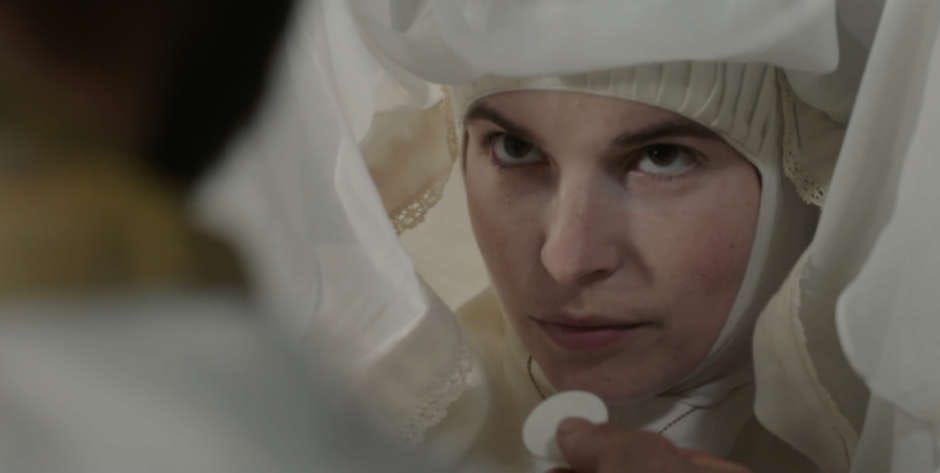
This is a frightening film, but it is rarely bloody or outright scary. It has a constant air of malice, like a cold earthen cellar. The gorgeous cinematography invites and repels with inky blacks and long hallways, where the shadows look like pools into another realm. Martín uses the geography of his limited setting brilliantly, but more than that, he expertly uses every inch of his sublime cast's uniquely interesting faces.
Watch, for example, how the costumes intentionally restrict movement, and how they conceal everything that lies beneath. These are suits of spiritual armor; their purpose is to strip away personhood. All that remains are the faces: inquisitive eyes and secret smiles at the corners of each mouth. Each cast member is fascinating. You could watch Upiro a dozen times, focusing on a different person each time, and it would still be a rewarding experience.
At times, Upiro is deliberately slow. Its terror comes from the unknowability of time, where days can stretch forever, yet years pass by in the blink of an eye. If you go in expecting tradition, Upiro will test your patience. But let go into its macabre delights and haunting recreations of the true horrors committed on women in the name of religion, and Upiro reveals itself as a grand, rich mosaic of fear that will haunt your dreams for years to come.